
Blog
Sports Memorabilia Authentication vs Appraisal: Why a Grading Slip Isn't a Valuation
A PSA or JSA certificate confirms an item is genuine and grades its condition, but it doesn't state a value. This guide explains why the IRS, insurers, and courts all require a separate, USPAP-compliant appraisal before a grading slip can support a deduction, claim, or legal proceeding.
A PSA slab or a JSA letter of authenticity tells you something important: the autograph is real, the card is genuine, and the condition has been graded against a defined standard. What it does not tell you is what the item is worth for your tax return, your insurance policy, or your divorce settlement. That gap between authentication and valuation causes more rejected deductions and denied claims than almost any other mistake collectors make.
This matters because the two services look similar on paper. Both involve an expert examining your item. Both produce a document with a reference number and an official-looking certificate. But authentication and appraisal answer two completely different questions, and only one of them produces a defensible opinion of value.
What Authentication and Grading Companies Actually Determine
Authentication and grading services answer a narrow question: is this item genuine, and what condition is it in? PSA's own service descriptions separate authentication and grading from appraisal as distinct steps, noting that an item is typically authenticated and graded first, and appraised only as a separate, later service.
For autographs, that process generally includes ink analysis, comparison against exemplars, and an evaluation of the signed object itself. For cards, it means comparing centering, corners, edges, and surface against a numeric scale. Neither process asks what a willing buyer would pay for the item in an open market, which is the actual question a valuation has to answer. Our comparison of PSA, JSA, Beckett, and SGC breaks down how each authenticator's methodology differs, but all four share the same limitation: they certify genuineness and condition, not dollar value.
General authentication guidance in the collectibles trade reinforces the same boundary: an authentication opinion addresses whether the item is what it claims to be, while pricing and market analysis are treated as a separate discipline entirely (collectibles authentication overview).
Watch out: A high grade does not set a price. A PSA 10 tells you the card is in gem-mint condition compared to other examples of the same card; it doesn't tell you what that specific card sold for last month or what a fair market value conclusion would be for a given date and purpose.
What a Formal Appraisal Actually Determines
An appraisal answers a different question: what is this property worth, for a stated purpose, as of a specific date? A properly prepared appraisal report identifies the item, states the intended use (an IRS filing, an insurance policy, an estate, a divorce proceeding), names the applicable type of value (fair market value, replacement value, liquidation value), documents the effective date, and walks through the market evidence and methodology that support the stated conclusion. It also discloses the appraiser's qualifications and any limiting conditions.
Appraisers working in personal property typically hold credentials through organizations such as the ISA, ASA, AAA, or CAGA, and prepare reports in accordance with the Uniform Standards of Professional Appraisal Practice (USPAP). Industry training for personal property appraisers draws a clear line here: appraisers are expected to identify the property accurately, but they are not typically the authenticators themselves. When genuineness is genuinely in question, the appraiser is expected to rely on recognized authentication experts, PSA, JSA, or another qualified specialist, rather than render their own opinion on whether a signature is real.
That division of labor is exactly why a grading slip and an appraisal report aren't interchangeable. One establishes genuineness and condition. The other builds a value conclusion on top of that foundation, using market sales data, the stated purpose, and a defined valuation date.
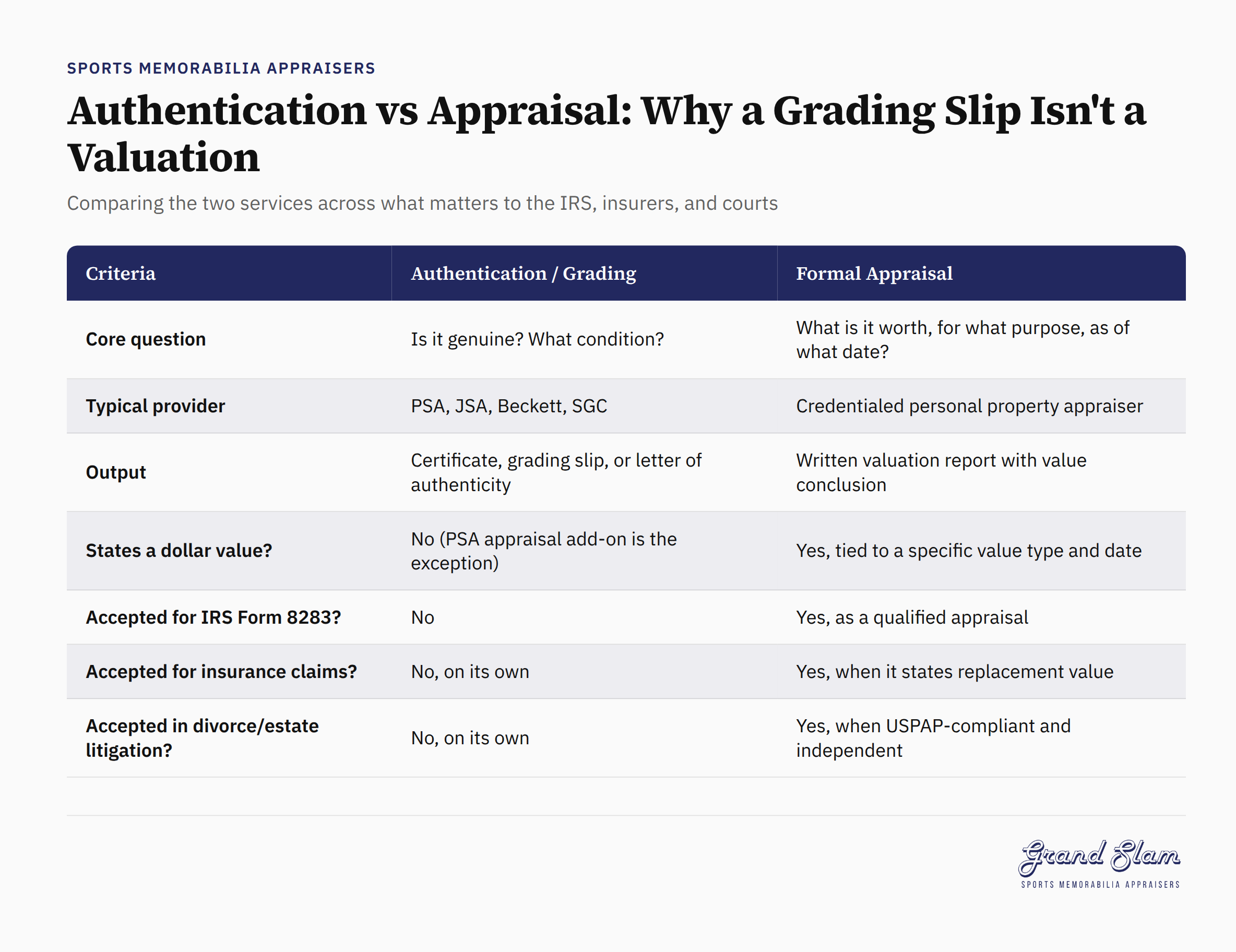
Authentication vs Appraisal: Side-by-Side
The table below lays out how the two services differ across the questions that actually matter to the IRS, an insurer, or a court.
| Authentication / Grading | Formal Appraisal | |
|---|---|---|
| Core question | Is it genuine? What condition is it in? | What is it worth, for what purpose, as of what date? |
| Typical provider | PSA, JSA, Beckett, SGC | Credentialed personal property appraiser |
| Output | Certificate, grading slip, or letter of authenticity | Written valuation report with a stated value conclusion |
| States a dollar value? | No (PSA's separate appraisal add-on is the exception, not the base service) | Yes, tied to a specific type of value and date |
| Accepted for IRS Form 8283? | No | Yes, when prepared as a qualified appraisal |
| Accepted for insurance replacement claims? | No, on its own | Yes, when it states replacement value |
| Accepted in divorce or estate litigation? | No, on its own | Yes, when USPAP-compliant and independent |
Why the IRS Won't Accept a Grading Slip as a Qualified Appraisal
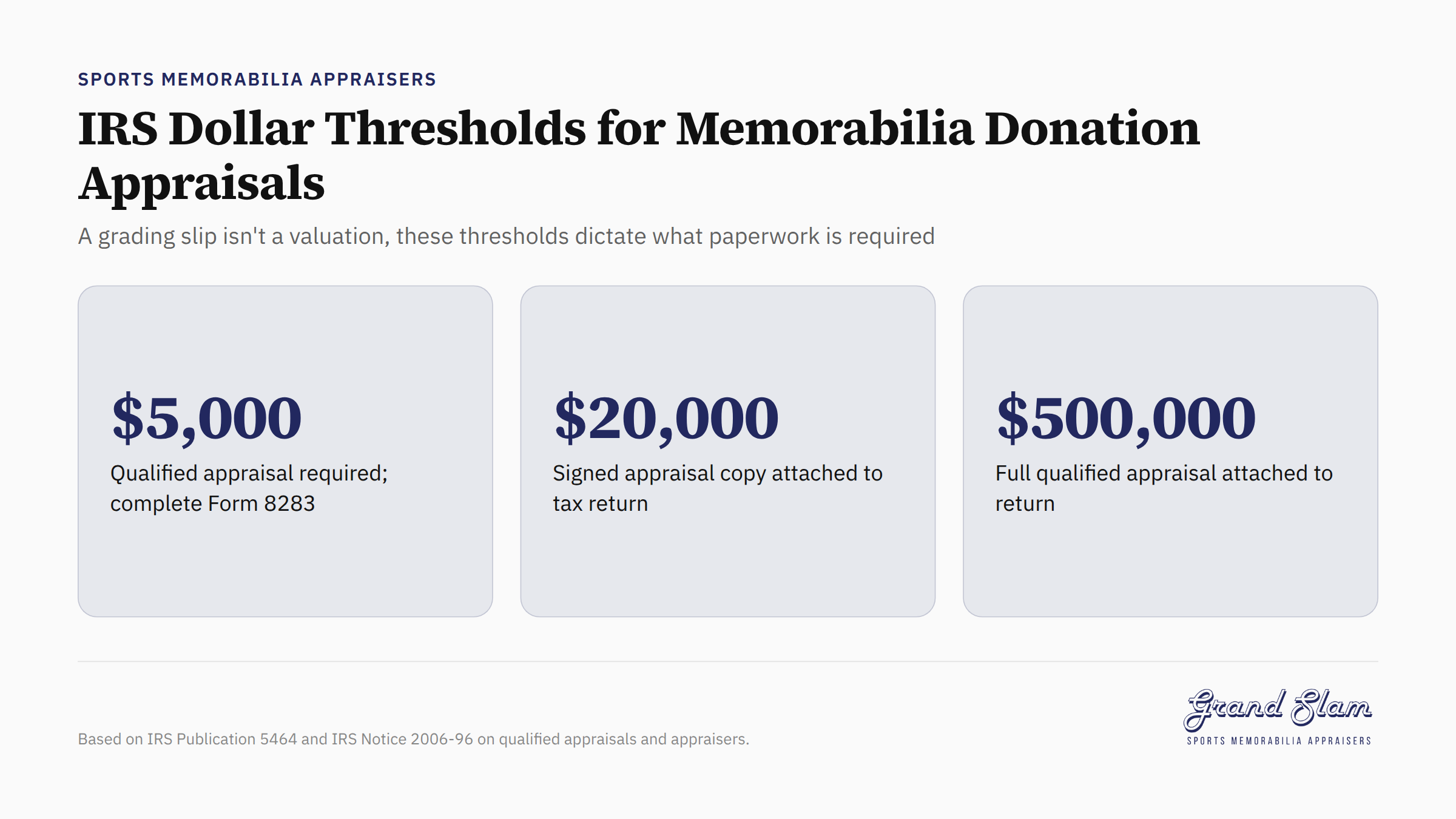
The short answer: a qualified appraisal has specific statutory requirements that a grading slip was never designed to meet. For non-cash charitable donations claimed above $5,000, the donor generally must obtain a qualified appraisal and complete the appraiser and donee sections of Form 8283. IRS guidance on charitable contribution reporting lays out those documentation requirements, and IRS Notice 2006-96 defines exactly what counts as a qualified appraisal and who qualifies as an appraiser for this purpose: someone who has earned a recognized appraisal designation, regularly performs appraisals for compensation, and is independent of the transaction.
A grading company fails that test on its own terms. PSA, JSA, Beckett, and SGC are authentication and grading businesses. Their certificates don't purport to be valuation opinions, don't state a value conclusion tied to a donation date, and aren't prepared by someone holding themselves out as an independent appraiser for that assignment. The IRS requirement isn't a formality; it exists because a valuation opinion and an authenticity opinion require different expertise and different disclosures.
Example: A collector donates a PSA 10 rookie card to a charitable auction and wants to claim a $25,000 deduction. The PSA grading slip confirms the card's condition and authenticity, which is useful supporting documentation, but it says nothing about fair market value as of the donation date. Without a separate qualified appraisal attached to Form 8283, the deduction is at serious risk of being disallowed on examination, regardless of how accurate the grade turns out to be.
The dollar thresholds that trigger these requirements are worth keeping straight, since they determine exactly what paperwork a donor needs.
What Insurers and Courts Expect That a Certificate Can't Provide
Insurers underwriting a scheduled collection need a replacement value, the cost to replace the item in the current market if it's lost, stolen, or damaged. That figure depends on recent comparable sales, not on a condition grade alone. A grading slip can support the file, but the insurer still needs a stated replacement value from an independent source before it will issue or adjust coverage at a specific number.
Courts in divorce and estate matters have the same requirement, for the same reason. A judge dividing marital property or an executor settling an estate needs a defensible opinion of fair market value as of a specific date, prepared by someone with no financial stake in the outcome. A grading company's certificate doesn't supply that opinion, and opposing counsel in a contested case will say so. A USPAP-compliant appraisal, by contrast, is built specifically to withstand that kind of scrutiny: it discloses methodology, market evidence, and the appraiser's independence up front.
Key takeaway: Whether the audience is the IRS, an insurer, or a judge, the common requirement is the same: an independent, dated opinion of value built on market evidence, not a condition grade.
How Appraisers Use Authentication in Their Research
None of this means grading certificates are worthless to an appraisal. They're often one of the first things a qualified appraiser asks for. A PSA or JSA certificate establishes genuineness and condition quickly, which lets the appraiser focus their research on comparable sales of similarly graded, similarly authenticated items rather than re-litigating whether the signature is real.
Pro tip: Keep your grading slips, authentication letters, and any provenance documentation together before requesting an appraisal. A complete file speeds up the appraiser's research and often results in a more precisely supported value conclusion.
What the appraiser adds on top of that certificate is the part a grading company doesn't do: pulling recent comparable sales for that specific grade and item, applying the correct type of value for the stated purpose, documenting an effective date, and signing a report under professional standards that the IRS, an insurer, or a court will actually recognize.
Authenticate First, Then Appraise
Treat authentication and appraisal as two sequential steps rather than one service. Get the item authenticated and graded first if there's any question about genuineness or condition, then have a qualified appraiser build the valuation on top of that foundation. Skipping the second step because you already have a certificate from the first is the single most common reason a donation deduction gets challenged, a claim gets underpaid, or a value gets disputed in court.
If you're preparing a donation, insurance schedule, or legal filing involving graded or authenticated memorabilia, our appraisers can request an appraisal and build a report around the documentation you already have.
This article is provided for general informational purposes only and does not constitute legal, tax, or financial advice. Readers should consult a qualified attorney or CPA regarding their specific circumstances.