
Blog
PSA vs JSA vs Beckett: Which Sports Memorabilia Authenticator Do Buyers Trust?
PSA, JSA, and Beckett each certify something different, and confusing autograph authentication with a professional appraisal can cost a collector real money. This guide breaks down what each service covers, when a hologram actually protects resale value, and which authenticator collectors lean on for cards, autographs, and game-worn items.
Anyone buying or insuring a signed jersey, an autographed baseball, or a graded rookie card eventually runs into three names: PSA, JSA, and Beckett. Each company certifies something slightly different, and treating their opinions as interchangeable, or as the same thing as a fair market value appraisal, is one of the most common mistakes collectors make. This guide walks through what each authenticator actually certifies, how their opinions differ from an appraiser's opinion of value, and when a hologram or certificate number genuinely protects resale value.
Our sports memorabilia appraisers field this question on nearly every intake call, because the answer changes depending on whether the item is a card, a single autograph, or a piece of game-used equipment.
What PSA, JSA, and Beckett Actually Certify
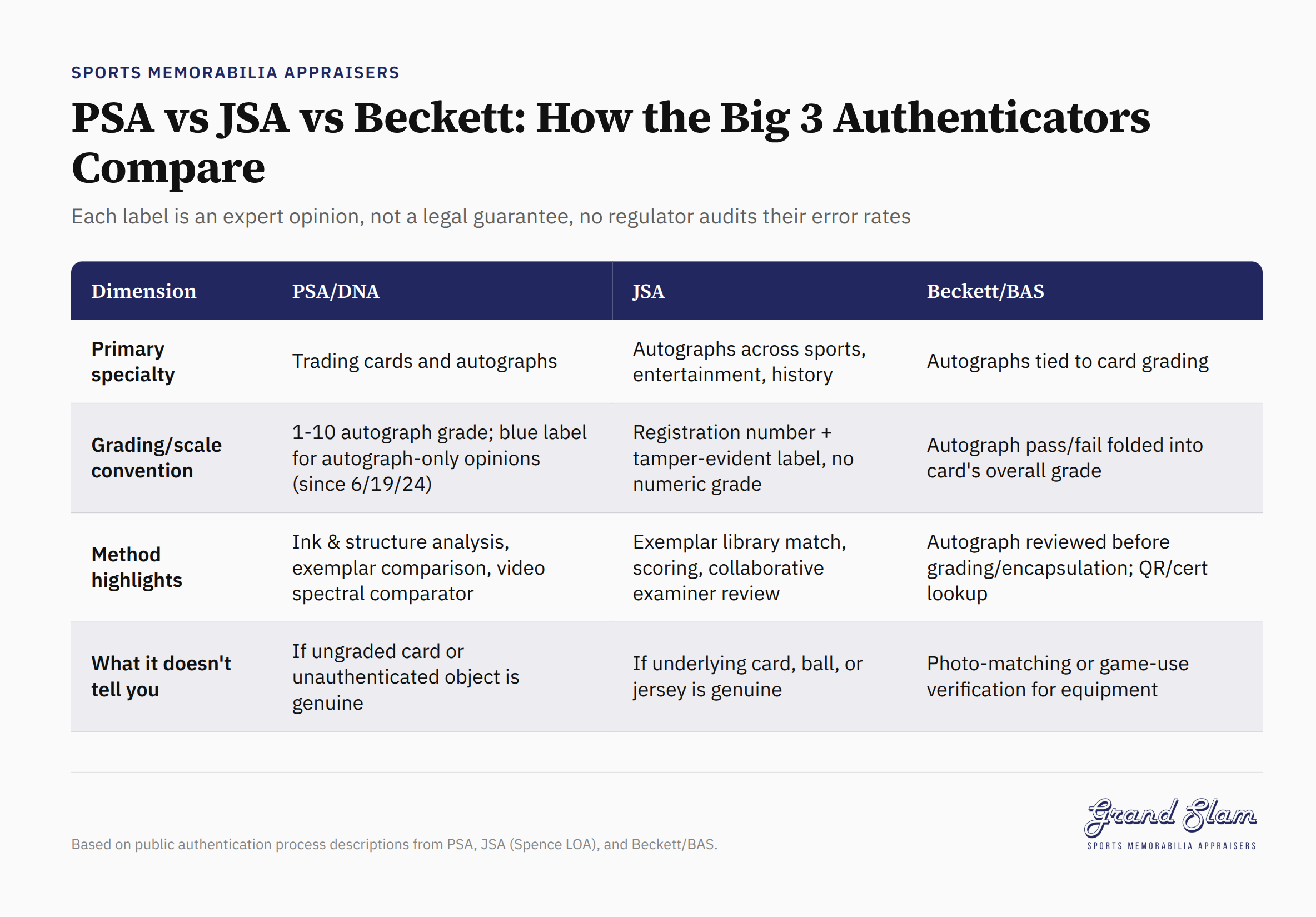
PSA/DNA, JSA (James Spence Authentication), and Beckett Authentication Services (BAS) each built their reputations in a different corner of the memorabilia market. PSA is best known for trading card grading and autograph authentication together. JSA focuses almost exclusively on autograph opinions across sports, entertainment, and historical categories. Beckett folds autograph review into its long-running card grading business.
The distinctions matter because a label from one company does not automatically mean the same thing as a label from another:
- PSA/DNA authenticates autographs using ink analysis, autograph-structure analysis, object evaluation, and side-by-side comparison with known exemplars, and uses a video spectral comparator when the case calls for it. PSA also grades autographs on a 1-10 scale, and since June 19, 2024, has issued a separate blue label to flag submissions where only the autograph, not the underlying card or object, was authenticated.
- JSA compares a signature against its own exemplar library, scores it, and reaches a determination through a collaborative examiner review. Certified items get a registration number and tamper-evident label; items that fail come back with a letter explaining the inconsistencies rather than a numeric grade.
- Beckett/BAS examines the autograph itself before the item proceeds to grading or encapsulation, and lets buyers check a certification number or QR code against Beckett's own records.
| Company | Primary specialty | Grading or scale convention | What it does not tell you |
|---|---|---|---|
| PSA/DNA | Trading cards and autographs | 1-10 autograph grade; blue label for autograph-only opinions | Whether an ungraded card or unauthenticated object is genuine |
| JSA | Autographs across categories | Registration number and tamper-evident label, no numeric grade | Whether the underlying card, ball, or jersey itself is genuine |
| Beckett/BAS | Autographs tied to card grading | Autograph pass/fail folded into the card's overall grade | Photo-matching or game-use verification for equipment |
None of these are government agencies, and no public regulator audits their error rates against one another. Each label represents that company's expert opinion, reached under its own internal process, not a legal guarantee.
Authentication Is Not the Same as an Appraisal
A certification from PSA, JSA, or Beckett is an opinion about genuineness. A professional appraisal is an opinion about value, prepared in accordance with the Uniform Standards of Professional Appraisal Practice (USPAP), and the two disciplines are not interchangeable even though they often work together on the same item.
Appraisers routinely identify property, but identifying an item and authenticating it are different tasks. In personal property appraisal, the general standard is that appraisers exercise due diligence to determine whether third-party authentication is warranted before relying on an opinion of genuineness, then factor an existing certification into the value conclusion rather than issuing their own authentication opinion. Credentialing bodies such as the ASA, ISA, and AAA train appraisers to this standard precisely because authenticating a signature or a game-worn jersey requires a different, narrower expertise than valuing it.
That separation also shows up in the invoice. Authentication fees are set independently by PSA, JSA, or Beckett, based on their own submission tiers and turnaround options, and those fees are entirely separate from an appraisal fee. When we scope a sports memorabilia appraisal, we quote a fixed fee before work begins; any third-party authentication a client chooses to pursue beforehand is billed directly by that company, not by us.
If you are still trying to figure out what an item might be worth before deciding whether authentication is worth the cost, our guide on how to find out what sports memorabilia is worth is a good starting point.
Key takeaway: a certificate answers "is this genuine," and an appraisal answers "what is this worth." A collector chasing a resale figure or an insurance value needs the second, and a strong authentication simply makes that appraisal more defensible.
When a Certificate or Hologram Actually Moves Resale Value
A certificate or hologram protects resale value only when a buyer can verify it directly against the issuing company's own records, and even then it reflects one company's opinion, not a guarantee enforced by any court or agency. Collectors should check a hologram's serial number directly on the authenticator's own verification page rather than trusting a photo of a sticker or a seller's description of one.
Grading and authentication can also carry a real market premium. Autographed cards that go through a formal grading and authentication process typically command higher resale prices than raw signed cards, because buyers are paying for reduced uncertainty, not just for the signature itself.
Watch out: a certificate is only as reliable as the company that issued it and the paperwork that travels with the item. A genuine PSA or JSA sticker does not, by itself, prove the chain of custody behind a jersey or ball. For items where provenance carries real weight, such as game-worn equipment or estate collections, see our guide on what documents prove provenance for a signed jersey or ball.
Where a certificate does not help much is in disputes over the underlying object rather than the signature. A genuine autograph can sit on a counterfeit or altered card, ball, or jersey, and a genuine card can carry a forged signature. Relevant legal protections in a dispute over a bad transaction generally come from state consumer-protection law or the state's adopted commercial code governing warranties on goods sold, not from the authenticator's label itself.
Which Authenticator Do Collectors Choose by Item Type?
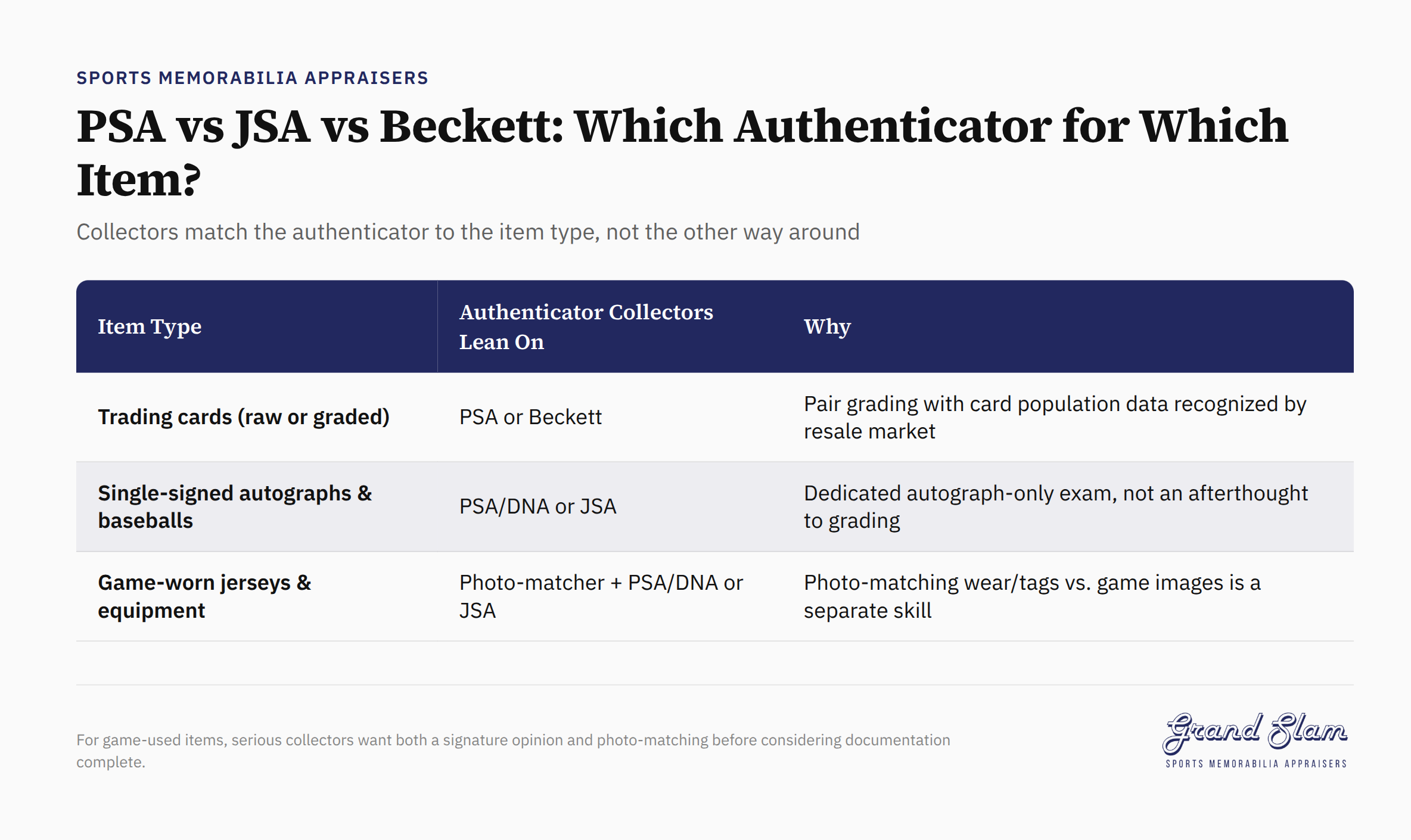
Collectors do not treat PSA, JSA, and Beckett as interchangeable; the market leans toward different services depending on the item.
| Item type | Authenticator collectors typically lean on | Why |
|---|---|---|
| Trading cards (raw or graded) | PSA or Beckett | Both companies pair grading with card population data, which the resale market already recognizes |
| Single-signed autographs and baseballs | PSA/DNA or JSA | Each runs a dedicated autograph-only examination process rather than treating the signature as an afterthought to grading |
| Game-worn jerseys and equipment | Photo-matching specialists working alongside a PSA/DNA or JSA autograph opinion | Matching an item to game photo or video evidence is a separate skill from signature comparison, and equipment often needs both |
For game-used items in particular, a signature opinion alone rarely settles the question of authenticity. Photo-matching, which lines up wear patterns, tagging, and equipment details against archival images from the actual game, is a distinct process from autograph review, and serious collectors typically want both before they consider a jersey or bat fully documented.
Putting It Together Before You Request an Appraisal
PSA, JSA, and Beckett each solve a narrow, specific problem: is this signature, and in some cases this card, genuine. None of them answer the broader question of fair market value, replacement cost, or what an item is worth for insurance, estate, or donation purposes. That is where a USPAP-compliant appraisal picks up, using any existing certification as supporting evidence rather than duplicating the authentication work.
If you have a signed, graded, or game-used item and need a defensible opinion of value, our team can review the certifications already on file and build the appraisal around them. Request an appraisal to get a fixed-fee quote scoped to your item and its intended use.