
Blog
Fair Market Value vs Replacement Value for Sports Memorabilia: Which Standard Applies to Your Collection?
Fair market value vs replacement value for sports memorabilia comes down to purpose: insurance uses replacement value, while estates, donations, and divorce use fair market value. This guide shows which number belongs on which document and why the two rarely match.
Your sports memorabilia collection can carry two very different dollar figures at the same time, and both can be correct. Fair market value is what a willing buyer and willing seller would exchange. Replacement value is what it would cost you to buy a similar item again. The one that applies depends entirely on why you need the appraisal.
The quick answer: an insurance coverage appraisal uses replacement value, while an estate tax appraisal, a charitable donation, or a divorce uses fair market value. Using the wrong one is the most common reason a collector's paperwork has to be redone. This guide covers both standards, how they differ for graded cards, signed jerseys, game-used bats, and autographed balls, and how to match each one to your situation.
What Is Fair Market Value for Sports Memorabilia?
Fair market value (FMV) is the price at which property would change hands between a willing buyer and a willing seller, neither being compelled to buy or sell, and both having reasonable knowledge of the relevant facts. IRS Publication 561 uses this definition for donated property, and the same concept anchors estate and gift valuation. It is a hypothetical transaction, not a quote from a shop.
For sports memorabilia, FMV is built from evidence of what comparable items actually sold for. That means completed auction results and documented sales of genuinely similar pieces, adjusted for the details that move price:
- Authentication: Third-party authentication on an autograph, or a grading slip on a card, changes who will bid and how much.
- Condition: A card's grade, a jersey's wear and repairs, a ball's toning or smudged signature.
- Provenance: Documentation tying a bat or jersey to a specific player and game, which is why game-used items behave so differently from team-issued ones.
- Scarcity and demand: Print runs, player legacy, and current collector interest.
- Date and venue: FMV is tied to a specific valuation date and to the market where the item would realistically sell.
Asking prices are weak evidence. They show what sellers hope to get, not what buyers paid.
What Is Replacement Value?
Replacement value is the cost to replace your item with a similar one, within a reasonable time, in the market where you would actually shop for it. It exists mainly for insurance: it answers "what would it take to put you back where you were before the loss?"
Because the standard follows the owner's shopping habits, a collector who buys through a specialty dealer or major auction house is measured against that retail channel, not a garage sale. A replacement figure typically also includes the costs that come with buying again:
- Sales tax or duties: Where they would apply to the purchase.
- Shipping and insurance in transit: High-value pieces rarely travel uninsured.
- Framing, mounting, or display cases: A framed jersey is not replaced with a loose one.
- Buyer's premium: Auction purchases usually carry one.
The exact inclusions depend on your policy's wording and the appraisal's stated definition of value, so confirm both before the work begins. Prepared in accordance with USPAP, an appraisal should state which definition it uses, the date, the intended user, and the market level.
Fair Market Value vs Replacement Value Compared
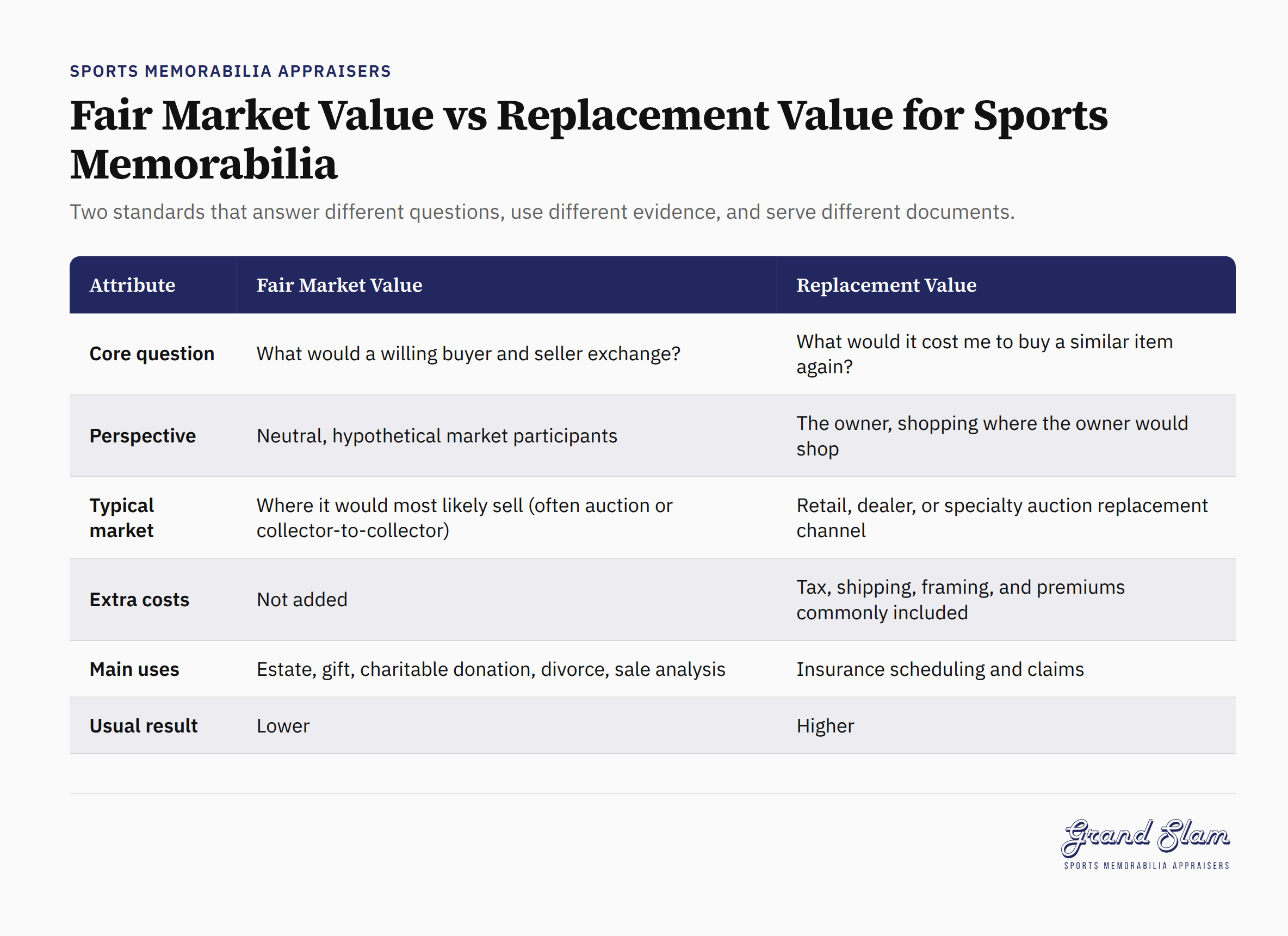
The two standards answer different questions, rely on different evidence, and serve different documents. The table below sets them side by side for a typical collection.
| Attribute | Fair Market Value | Replacement Value |
|---|---|---|
| Core question | What would a willing buyer and seller exchange? | What would it cost me to buy a similar item again? |
| Perspective | Neutral, hypothetical market participants | The owner, shopping where the owner would shop |
| Typical market | Where the item would most likely sell (often auction or collector-to-collector) | Retail, dealer, or specialty auction replacement channel |
| Extra costs | Not added | Tax, shipping, framing, and premiums commonly included |
| Main uses | Estate, gift, charitable donation, divorce, sale analysis | Insurance scheduling and claims |
| Usual result | Lower | Higher |
Why Do the Two Numbers Differ?
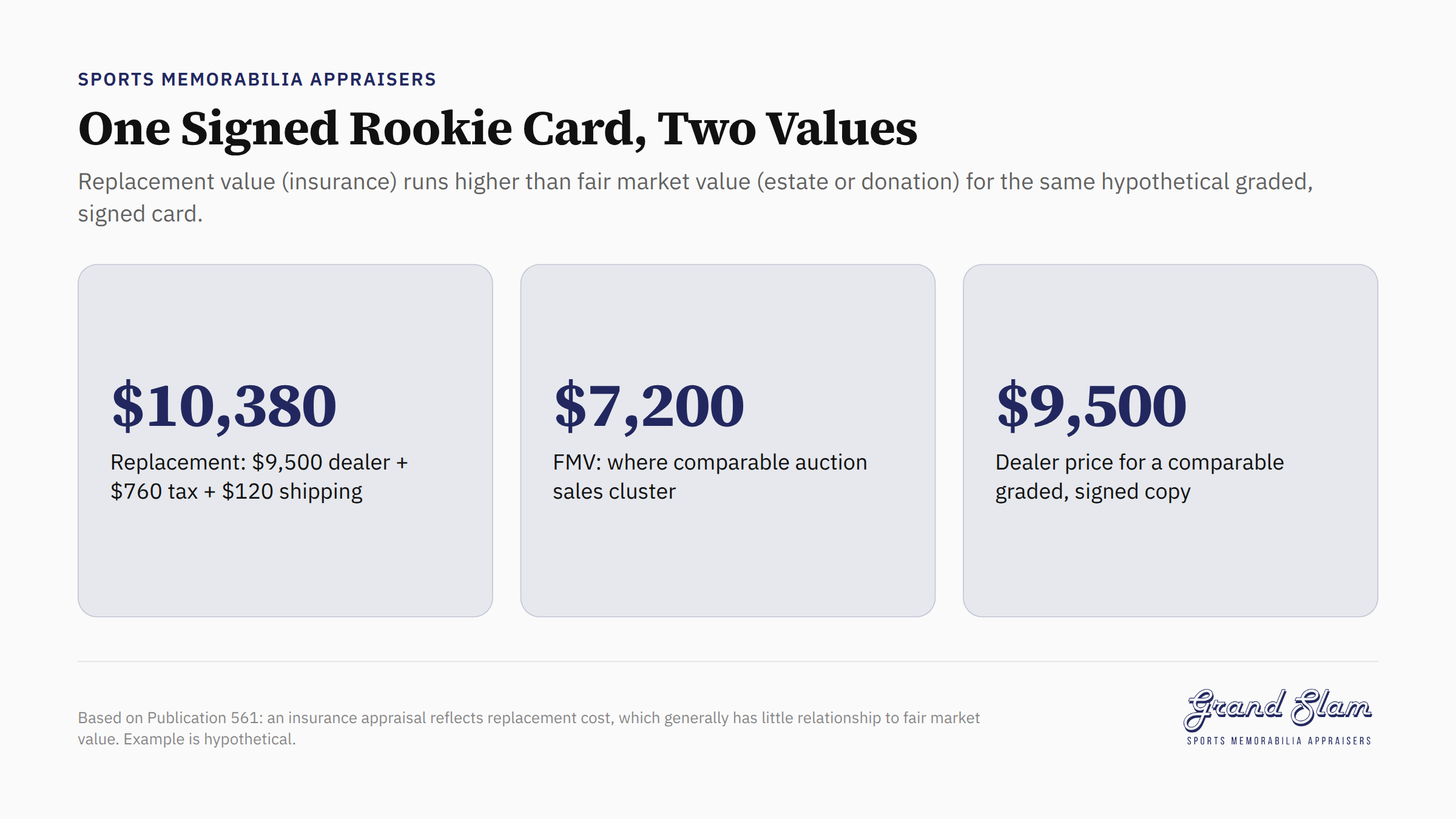
Replacement value usually runs higher because it reflects retail pricing, dealer margins, and the cost of locating a comparable piece, while FMV reflects the price a seller would realistically net. Publication 561 addresses this directly: an insurance appraisal reflects replacement cost, and replacement cost generally has little relationship to fair market value.
Example: Take a hypothetical rookie card, professionally graded and signed by the player with third-party authentication. A dealer currently lists a comparable graded and signed copy at $9,500. To replace it you would also pay 8% sales tax ($760) and insured shipping ($120), so the replacement value is $9,500 + $760 + $120 = $10,380.
Now look at what comparable copies have actually sold for at auction over the past year. They cluster around $7,200 because buyers at auction do not pay dealer retail and sellers absorb fees. A willing buyer and willing seller would exchange roughly $7,200, so that is the FMV.
Neither number is wrong. The $10,380 figure keeps your insurance whole after a theft, and the $7,200 figure is what an estate or donation return can defensibly report.
The gap widens for one-of-a-kind items. A game-used bat with documented provenance may have no true substitute, so a replacement appraisal has to define what "equivalent" means: same player, same era, same level of use, same documentation. Without that definition, the number is guesswork.
Which Value Applies to Your Situation?
Match the standard to the purpose, not to the number you happen to like. The matrix below maps the most common reasons for an appraisal to the value that applies.
| Purpose | Value Standard | Why |
|---|---|---|
| Insurance coverage or claim | Replacement value | Policies pay to replace, subject to the policy's loss-settlement terms |
| Estate tax or probate | Fair market value | Valued as of the date of death (or alternate date where available) |
| Charitable donation | Fair market value | Deduction is based on FMV on the date of contribution |
| Divorce and equitable distribution | Fair market value | Property is divided at what it would realistically bring |
| Sale or purchase planning | Fair market value | Comparable completed sales drive the analysis |
Pro tip: Read your policy before commissioning an insurance appraisal. Some policies pay replacement cost, others pay agreed value or a scheduled amount, and a few pay actual cash value. The appraisal should support whichever wording your policy uses.
Our appraisers prepare each of these as a separate assignment, including donation appraisals where the IRS rules below apply.
What the IRS Says About Sports Memorabilia Donations
For federal tax purposes, sports memorabilia is a collectible. The Form 8283 instructions group collectibles together as items the IRS expects to be valued carefully, and Publication 561 lists sports memorabilia by name among them.
Three thresholds matter for donors:
- Over $500 in total noncash gifts: Form 8283 is generally required with your return.
- Over $5,000 for an item or group of similar items: A qualified appraisal is generally required, and the donation is reported in Section B of Form 8283 with the appraiser's signed declaration.
- Valuation timing: The appraisal must generally be dated no earlier than 60 days before the gift and no later than the return's due date, including extensions, and it must state the value as of the contribution date.
Example: A collector donates a signed jersey and 3 signed balls to a museum. If the group is of similar items and together is worth more than $5,000 in FMV, the qualified appraisal requirement applies, and the replacement figure from the homeowner's policy is irrelevant to the deduction.
Watch out: Similar items are aggregated. Several small gifts of the same type in one tax year can cross the $5,000 line even when no single item does. Our guide to what the qualified appraiser signs on Form 8283 walks through the declaration.
Can You Reuse an Insurance Appraisal for an Estate or Donation?
No. An appraisal is written for one intended use, one valuation date, and one definition of value, and it cannot safely be recycled for another purpose. An insurance appraisal states replacement value as of its own date. Handing that report to an estate attorney or attaching it to Form 8283 puts a retail-based figure into a filing that calls for FMV on a specific legal date.
The reverse also fails. A donation or estate appraisal states a lower FMV, and if you file it with your insurer as your coverage amount, you risk being underinsured. A claim could then be settled against a number that was never meant to represent replacement cost.
The practical rules are straightforward:
- Tell the appraiser the purpose first. The intended use determines the value standard, the market, and the report's required content.
- Order a separate report for each purpose. One collection can need an insurance report this year and an estate report later.
- Refresh insurance values periodically. Replacement costs move with the market, and an old schedule can leave a collection underinsured.
- Do not use a grading slip as a valuation. A grade or authentication opinion is not an appraisal, as we explain in authentication vs appraisal.
How We Handle the Two Standards
Our appraisers hold credentials with leading organizations such as the ISA, ASA, and AAA, and every report is prepared in accordance with USPAP and the requirements of its intended use. Each report states the purpose, intended user, valuation date, definition of value, and the comparable sales or replacement sources behind the conclusion. Whether the reviewing party, such as the IRS, an insurer, or a court, accepts a report is that party's decision, not ours.
Engagements are quoted as a fixed fee before work begins, never billed hourly. The fee reflects scope: the number and complexity of items, the completeness of your records, whether the report must meet IRS qualified-appraisal requirements, and the depth of research. It does not change with how valuable your collection turns out to be.
Match the Standard Before You Order the Report
Decide what the appraisal is for before anything else. If the answer is insurance, you need replacement value. If it is an estate, a donation, or a divorce, you need fair market value, and the report should be built to those rules from the start.
Tell us the purpose and the items in your collection, and we will prepare the right report for your situation.
This article is provided for general informational purposes only and does not constitute legal, tax, or financial advice. Readers should consult a qualified attorney or CPA regarding their specific circumstances.