
Blog
Game-Used vs Game-Worn vs Team-Issued: Why the Label Changes Your Item's Value
Game-used, game-worn, and team-issued sound interchangeable but sit on very different value tiers. This guide explains what each label actually proves, how photo-matching separates the real from the marketed, and why an appraiser has to document the tier rather than take a seller's word for it.
A jersey tagged "game-used" and one tagged "team-issued" can look identical on a shelf and sell for wildly different prices. The gap comes down to what the label is actually claiming, and whether anyone can prove it. Our appraisers see this constantly when preparing insurance appraisals for jersey, bat, and ball collections, because a policy scheduled at the wrong evidentiary tier either overpays for coverage or leaves a collector underinsured after a claim.
This guide breaks down what game-used, game-worn, and team-issued actually mean in the hobby, how authentication firms establish which tier an item belongs to, and why that distinction changes both market value and appraisal documentation.
What Does "Game-Used" Actually Mean?
Game-used is the broadest of the three terms. It covers any piece of equipment or apparel that was used in a professional sporting event, and it applies to items a player could never wear: bats, balls, gloves, bases, sticks, and helmets all fall under this label. Topps' own glossary defines game-used memorabilia as a piece that has been used in a professional game, and treats it as the umbrella term for relic material regardless of whether the object was worn.
That breadth is exactly why the term needs a second look before anyone assigns it a value. "Used" does not automatically mean tied to a specific game, date, or milestone. Many relic cards carry small-print disclosure language stating the piece is "not from any specific game, event, or season," a distinction Sports Illustrated's collectibles coverage points out is easy for buyers to miss when the front of the card just says "game-used." A bat that saw action in one at-bat during a random regular-season game is still game-used, but it sits in a very different market than a bat used in a World Series game-winning hit.
Why Bats and Balls Are Rarely Called "Game-Worn"
Worn implies something a player puts on. Bats, balls, gloves, bases, and sticks are handled and used, but not worn on the body, so the hobby consistently reserves "game-worn" for apparel and equipment that sits on a player's frame: jerseys, uniforms, helmets, cleats, and batting gloves. Collectors and dealers describe game-used as the cover-all term precisely because it also has to accommodate equipment that game-worn cannot describe.
Game-Worn: A Narrower, Higher-Value Subset
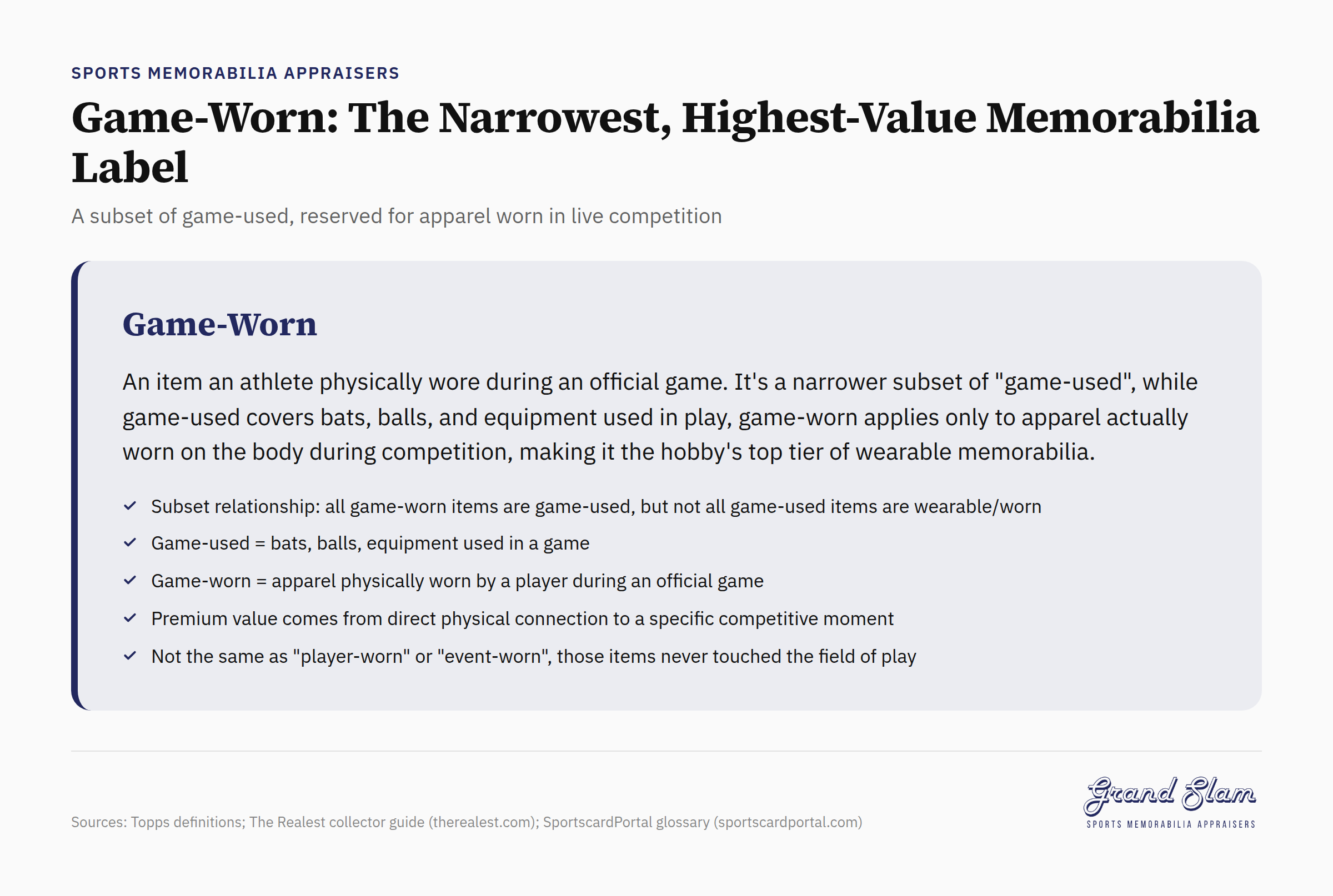
Game-worn means an athlete physically wore the item during an official game, which makes it a subset of game-used rather than a separate category. Topps defines game-worn as memorabilia worn by a player in an official game, and hobby guides consistently rank it as the top tier of wearable memorabilia because the item was literally on the field during competition.
The premium exists because game-worn status implies a direct, physical connection to a specific competitive moment, something The Realest's collector guide calls the highest tier of sports collectibles for exactly that reason. SportscardPortal's glossary makes the same point: game-worn is generally the most desirable wording in the hobby because it signals actual use in live competition, not brief handling in a controlled setting.
Watch out: "Player-worn" and "event-worn" are not the same as game-worn. Those terms describe an item the athlete put on outside of a game, often for a few seconds at a photo shoot, autograph signing, or rookie premiere event. It is authentic to the player, but it never touched the field of play, and it should be priced accordingly.
Team-Issued and Game-Issued: Authentic Gear That Never Saw Action
Team-issued, sometimes called player-issued or locker room issued, describes equipment produced to a team's or player's exact specifications but never actually used in a game. These items are genuine team stock, often indistinguishable from game-used gear on visual inspection alone, but they lack the one thing that drives the top tiers of value: confirmed use in competition.
SportsCleanout's comparison of the categories describes team-issued or player-issued items as created for professional use but never seeing game action, made to the same specifications as items that did. Because the gear is identical in construction, the only reliable way to separate a team-issued jersey from a game-worn one is documentation, not appearance.
That absence of in-game evidence is the reason team-issued items sit well below authenticated game-used or game-worn pieces on the price ladder. A jersey that matches a player's size and number tells you the team prepared it for that player. It does not tell you the player ever wore it on the field, and buyers pay accordingly.
Photo-Matching: The Strongest Form of Proof
Photo-matching is the process of comparing an item's unique physical characteristics against archival game photography or video to confirm it was used in a specific, identifiable game. Authenticators examine details like mesh-hole spacing on a jersey, stitching irregularities, stray tape jobs on a bat handle, stain patterns, and wear marks, then line those details up frame by frame against images from the game in question.
Third-party authentication firms including MEARS, PSA/DNA, and Resolution Photomatching built their reputations on this kind of granular comparison work, and it is now standard practice across the hobby whenever a seller claims an item is tied to a specific date or milestone. Sports Collectors Digest reported that MEARS and JSA streamlined a joint process for submitting signed game-worn, game-used, or game-issued memorabilia for dual review, pairing autograph authentication with photo matching so a single submission produces both a signature opinion and a wear-pattern match report.
A successful photo match, backed by a written letter of authenticity, is treated as close to definitive proof in the hobby. It is also the clearest documentation an appraiser can point to when explaining why an item commands a premium over a similar, unmatched piece. Our appraisers rely on this kind of paper trail heavily when preparing reports that need to withstand outside scrutiny; see our companion guide on what documents actually prove provenance for a full rundown of the paperwork that should accompany a high-value piece.
MLB's In-Stadium Hologram Program: Provenance at the Moment of Use
One case sidesteps the after-the-fact detective work entirely. Major League Baseball runs an in-stadium authentication program in which league-authorized observers tag equipment and apparel with a tamper-evident hologram at the moment it comes out of play, whether that is a home run ball, a milestone jersey, or a lineup card. Because the tag is applied on-site during the game itself, there is no need to reconstruct provenance later through photo comparison.
This is provenance established at its strongest possible point: the instant of use, witnessed and recorded in real time. It is worth understanding as the gold standard against which after-the-fact photo-matching is measured, since photo-matching exists precisely to recreate, years or decades later, the certainty that an in-stadium hologram program captures on the spot.
Why Rigorous Authentication Became the Norm
The hobby's current emphasis on photo-matching and documented chains of custody did not appear by accident. In the late 1990s, a federal investigation known as Operation Bullpen uncovered a large-scale forgery ring producing and selling counterfeit autographs and fabricated memorabilia across the country, exposing just how much fraudulent material had entered the market under confident-sounding labels.
That episode, along with a steady stream of smaller forgery cases since, is a major reason auction houses, grading services, and appraisers now insist on independent documentation rather than a seller's description alone. A label is only as good as the paperwork behind it.
Comparing the Three Value Tiers
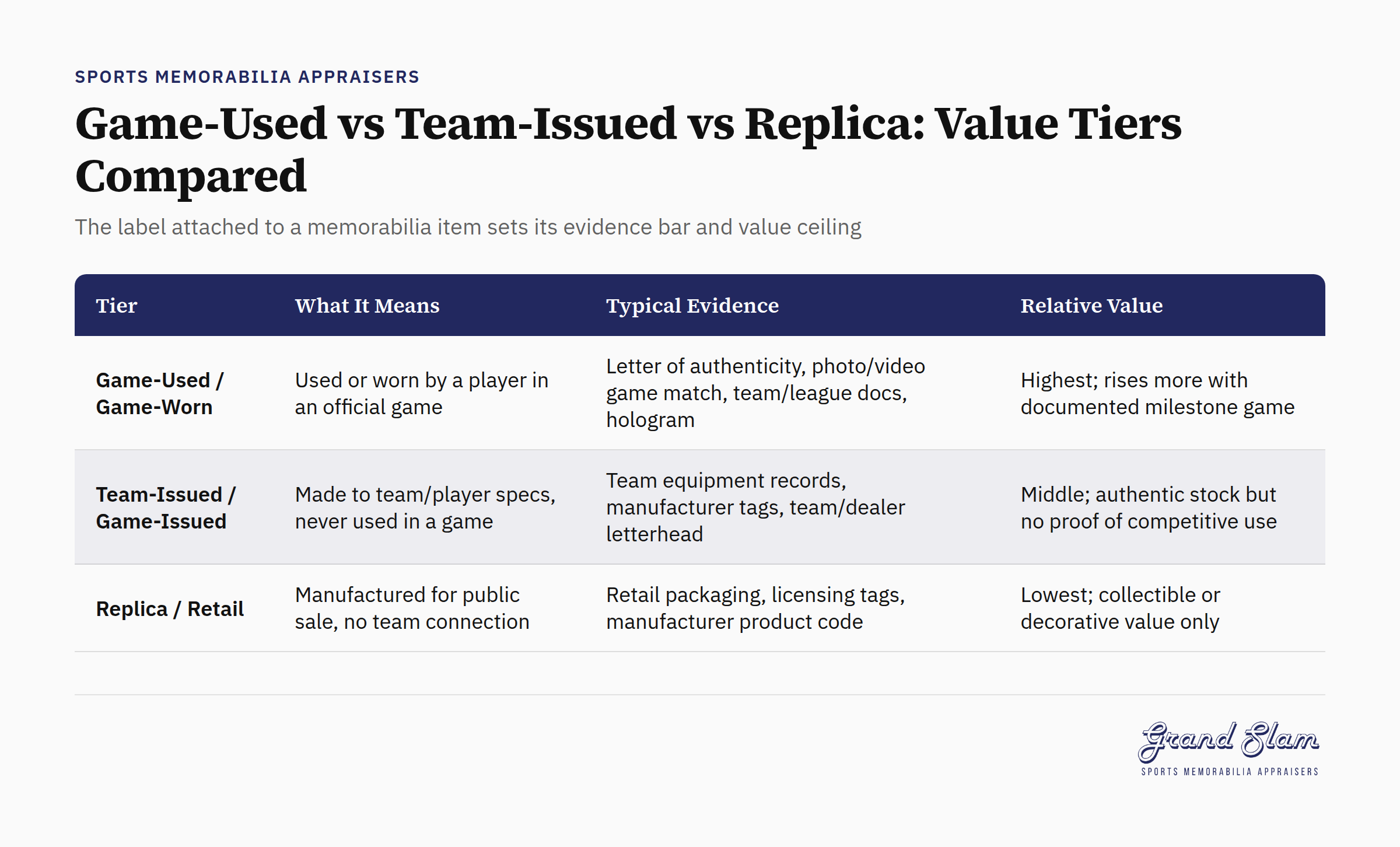
The practical difference between these labels shows up clearly when you line them up side by side. Each tier carries a different type of evidence and a different ceiling on value, independent of how good the item looks in a display case.
| Tier | What It Means | Typical Evidence | Relative Value |
|---|---|---|---|
| Game-used / Game-worn | Used or worn by a player during an official competitive game | Letter of authenticity, photo/video match to a specific game, team or league documentation, in-stadium hologram | Highest; premium increases further with a specific, documented game or milestone |
| Team-issued / Game-issued | Produced to team or player specifications but never used in a game | Team equipment records, manufacturer tags, dealer or team letterhead confirming issuance | Middle; authentic team stock without proof of competitive use |
| Replica / Retail | Manufactured for public sale, not connected to any team inventory or player | Retail packaging, licensing tags, manufacturer's product code | Lowest; collectible or decorative value only |
Why the Label Matters for Insurance and Estate Appraisals
An appraiser's job is to identify which tier an item actually occupies, not to repeat whatever description came with it at purchase. A seller's listing that says "game-used" is a claim, not a finding, and a defensible appraisal report has to state what evidence exists (or does not exist) to support that claim.
This matters most in two settings. For an estate tax or probate appraisal, the IRS expects a report that documents the basis for the concluded value, and an unsupported game-used claim on a high-dollar jersey invites exactly the kind of scrutiny that slows down a filing. For insurance scheduling, a policy written against an inflated tier leaves the collector paying premiums on a value the item cannot actually support, while a policy written too low undercompensates after a covered loss.
A report prepared in accordance with USPAP has to describe the reasoning behind the value conclusion, which means documenting the authentication paperwork, any photo-match reports, and the specific tier the appraiser is relying on. That documentation is what lets a report stand up to a lender, an insurance adjuster, or a tax examiner asking how the number was reached.
Key takeaway: The word on the tag or the auction listing is a starting point, not a conclusion. The value gap between game-worn, team-issued, and retail material is large enough that verifying the tier, through photo-matching, league documentation, or authentication letters, should happen before a number ever goes on an appraisal report.
This article is provided for general informational purposes only and does not constitute legal, tax, or financial advice. Readers should consult a qualified attorney or CPA regarding their specific circumstances.