
Blog
How to Value a Sports Memorabilia Collection for Probate and Estate Tax
Executors settling an estate with cards, jerseys, or autographed items must decide whether to value them individually or as a group, since IRS aggregation rules can turn a shoebox of cards into a required formal appraisal. This guide covers date-of-death fair market value, the alternate valuation election, and exactly when a written appraisal is legally required for Form 706.
When a collector dies holding a run of graded rookie cards, a game-worn jersey, or a shelf of autographed baseballs, the executor inherits a valuation problem most probate checklists never mention. Sports memorabilia doesn't fit neatly into "household goods" or "jewelry," and getting the valuation wrong, either by overstating value and overpaying estate tax, or understating it and inviting an IRS challenge, creates real liability for whoever signed the return. This guide walks through the three decisions every executor faces: whether to value items individually or as a group, how to pin down fair market value as of the date of death, and when the law actually requires a formal written appraisal.
Our team handles sports memorabilia appraisals for estate tax purposes regularly, and the same mistake shows up again and again: executors appraise a $200 card here and a $150 ball there, never realizing the IRS looks at the collection as a whole.
The Three Decisions Every Executor Must Make
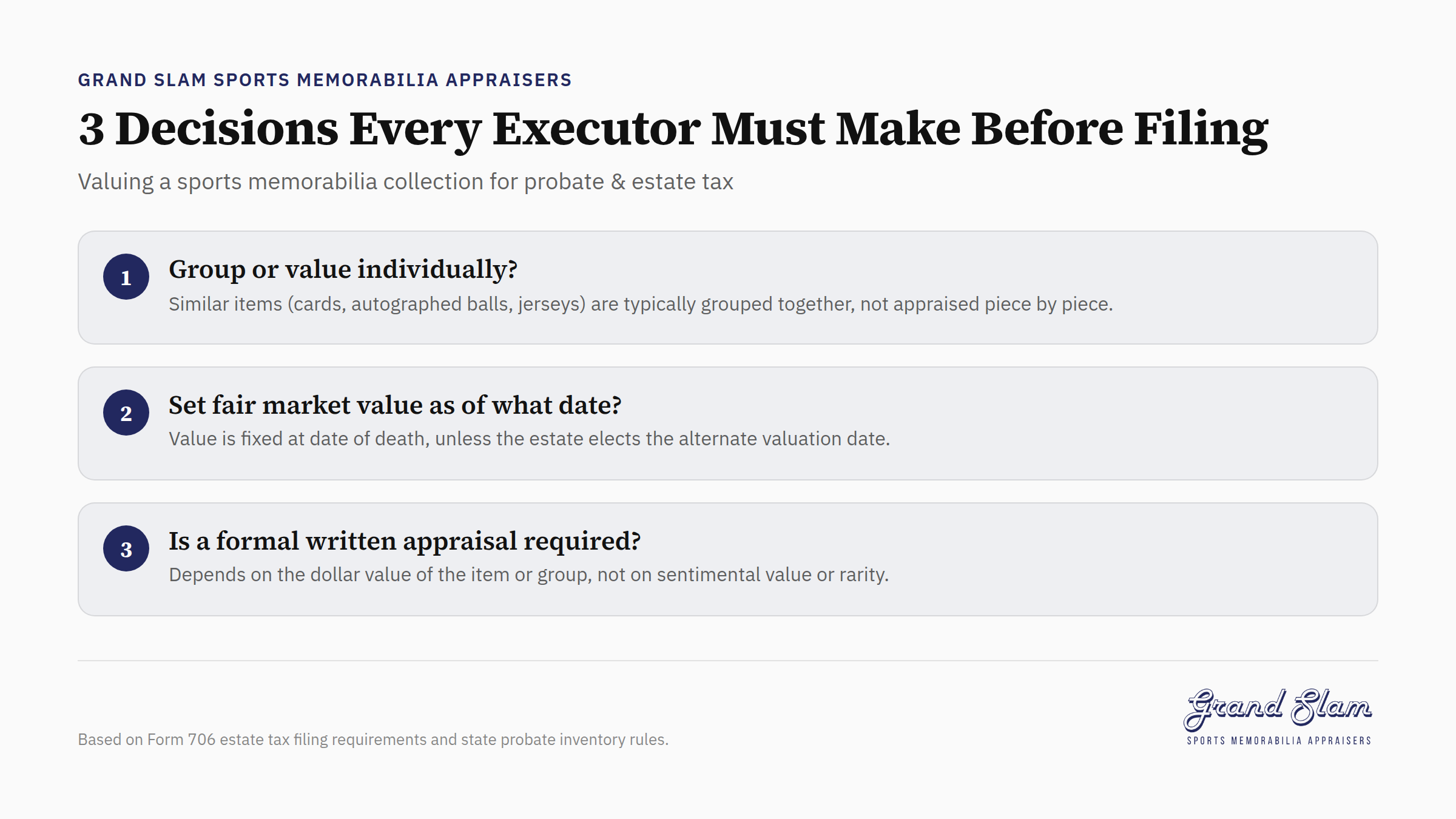
Every sports memorabilia collection moving through probate requires the executor to resolve three things before Form 706 or the state probate inventory gets filed. Skipping any one of them is how estates end up amending a return months later.
- Individual items or a collection? Similar items (all the cards, all the autographed balls, all the jerseys) generally get grouped together for valuation purposes, not appraised piece by piece against a dollar threshold.
- What is the fair market value, and as of what date? The estate tax value is fixed at the date of death, unless the estate elects the alternate valuation date.
- Does the law require a formal written appraisal, or will a good-faith estimate hold up? This depends on the dollar value of the item or the group it belongs to, not on how sentimental or rare the executor believes it to be.
Should You Appraise Each Item or the Collection as a Whole?
The IRS does not evaluate a sports memorabilia collection card-by-card when applying its dollar thresholds. It looks at "similar items," grouped by category, which is the single most common mistake executors make.
A collection of 40 vintage baseball cards, none individually worth more than $200, might total $8,000 once aggregated. A set of autographed jerseys from the same era, each modestly priced on its own, can cross a reporting threshold once totaled as a group. Treating each item as its own isolated asset, and skipping an appraisal because no single piece looks expensive, is exactly the error that draws IRS scrutiny during an estate tax audit or a state court's review of the probate inventory.
Establishing Date-of-Death Fair Market Value
Fair market value for estate purposes is defined in the Treasury regulations governing estate tax valuation as the price at which property would change hands between a willing buyer and a willing seller, neither under any compulsion to act, and both having reasonable knowledge of the relevant facts. The IRS defines fair market value in Publication 561 in nearly identical terms, and this is the standard used across every category of personal property, from real estate down to a single autographed jersey.
For sports memorabilia specifically, that means the executor (or the appraiser working on the estate's behalf) needs to anchor the valuation to actual market data as close to the date of death as possible: recent comparable auction results, graded-card marketplace sales, and dealer pricing for equivalent items in equivalent condition. A card that sold for $4,000 two years before the decedent's death and $9,000 six months after it tells the executor almost nothing about value on the date that matters. Sports memorabilia markets move fast, driven by a player's Hall of Fame vote, a record-breaking season, or a documentary that suddenly puts a jersey back in demand, so stale comparables are a common source of disputed valuations.
Pro tip: Pull comparable sales from the same calendar quarter as the date of death whenever possible, not just the same year. Memorabilia values for a given player or era can shift meaningfully within a few months.
The Alternate Valuation Date: A Six-Month Window
Estates that expect the value of their assets, including a memorabilia collection, to decline in the months after death have the option to elect an alternate valuation date under federal estate tax law. That election shifts the valuation point to six months after death (or an earlier disposition date, if items are sold sooner) instead of the date of death itself.
This election applies to the entire estate, not to individual assets, so an executor cannot use the date of death for real estate and the six-month mark for a memorabilia collection just because the numbers work out better that way. The election only makes sense when the estate's overall value is trending downward and the lower valuation reduces the estate's total tax liability. A memorabilia collection experiencing a short-term price spike right after death (say, a player's sudden Hall of Fame induction driving up card values) is a case where the standard date-of-death value, not the alternate date, will usually be the better outcome for the estate.
When Is a Formal Written Appraisal Legally Required?
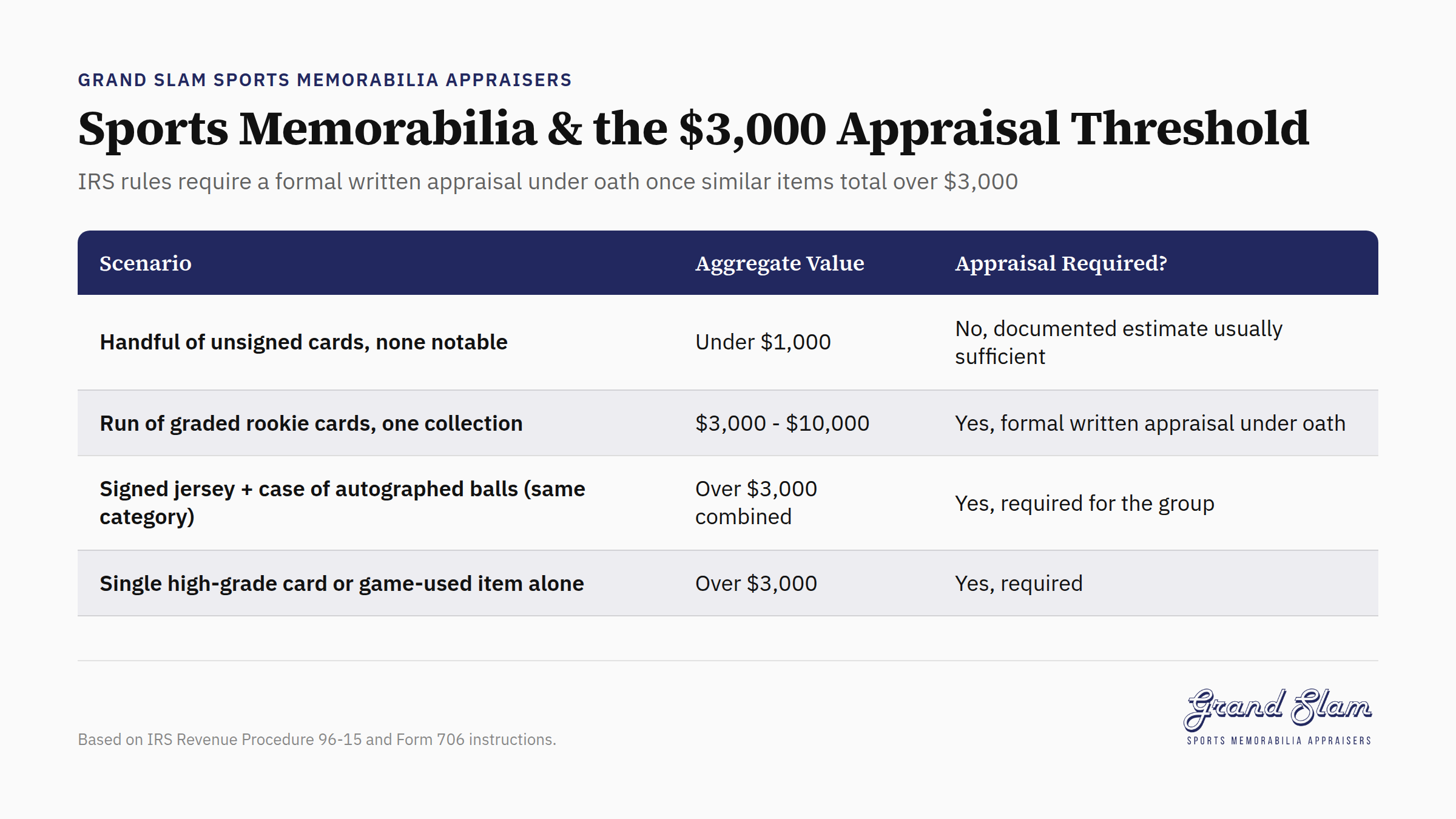
Direct answer: A formal written appraisal, under oath, from a qualified expert becomes a filing requirement whenever a single item, or a collection of similar items, is valued at more than $3,000. Below that threshold, a documented good-faith estimate supported by market comparables is generally sufficient.
This $3,000 figure comes from long-standing IRS guidance on how estates must substantiate the value of works of art, collections, and similar property attached to an estate tax return. The IRS guidance in Revenue Procedure 96-15 sets out the appraisal-under-oath requirement for items or collections above this level, and Form 706's instructions carry the same standard forward for estates filing a federal estate tax return today. Because sports memorabilia is grouped as "similar items" rather than appraised piece by piece, a collection that looks modest item-by-item can still trip this threshold once totaled.
The table below summarizes how the threshold typically plays out for a memorabilia estate.
| Scenario | Aggregate Value | Appraisal Required? |
|---|---|---|
| A handful of unsigned cards, no single card notable | Under $1,000 | Documented estimate is usually sufficient |
| A run of graded rookie cards from one collection | $3,000 - $10,000 | Formal written appraisal under oath required |
| One signed jersey plus a case of autographed balls, same category | Over $3,000 combined | Formal written appraisal required for the group |
| A single high-grade card or game-used item on its own | Over $3,000 | Formal written appraisal required |
Estates that skip the appraisal because "nothing in the box looked expensive" are the ones most likely to face a follow-up request for documentation, or worse, a revaluation, during an IRS review of the return.
What Drives Value in Sports Memorabilia
Authenticity, provenance, and condition move memorabilia values more than almost any other collectible category, and each needs its own line of documentation in the estate file. A jersey without a letter of authenticity or a photo-match report can be worth a fraction of an identical, properly certified piece. Grading certification from a recognized service materially changes a card's market value, sometimes by an order of magnitude between adjacent grades.
An appraiser working a sports memorabilia estate typically documents the following for each item or group:
- Player, team, and year: the baseline identifiers that determine which comparable sales apply.
- Grading or certification status: the specific service and grade (PSA, SGC, BGS, JSA, or similar), since ungraded items are valued differently than certified ones.
- Authentication and provenance: letters of authenticity, photo-matching, or a documented chain of ownership back to the decedent's acquisition.
- Condition: wear, staining, or damage not captured by a grading label, particularly for game-used equipment and jerseys.
Estate planning attorneys who work with collectors routinely flag missing authentication paperwork as the single biggest gap they see when a memorabilia collection reaches probate without prior planning. If the decedent kept purchase receipts, certificates, or prior appraisals, the executor should locate them before the appraisal begins; it materially speeds up the process and strengthens the resulting report.
Watch out: Sentimental value and market value are not the same thing. A jersey the decedent wore to every game may mean nothing to a buyer without documentation proving it belonged to a notable player or event.
Building a Probate File the IRS Won't Challenge
An estate tax return that gets challenged months or years after filing is far more expensive to fix than getting the appraisal right the first time. The valuation methodology used for determining what sports memorabilia is actually worth for a sale is a useful starting point for an executor doing initial triage, but it isn't a substitute for a formal appraisal once the collection crosses the $3,000 aggregation threshold.
A complete probate file for a memorabilia collection should include the grouped inventory (by category, not scattered item-by-item), the comparable sales data supporting each valuation, authentication and grading documentation, and, where the threshold applies, a signed appraisal under oath from a qualified appraiser. Our sports memorabilia appraisal for probate assembles exactly this file for the personal representative or executor. Engagements for this kind of work are quoted as a fixed fee once the collection has been scoped, based on the number of items, the depth of research required, and whether the report needs to meet the IRS-qualified standard for Form 706.
Executors dealing with an unfamiliar collection, or a large one, are better served bringing in a specialist early rather than guessing at values and hoping the IRS doesn't ask questions later. If a sports memorabilia collection is part of an estate you're settling, our team can scope and prepare the estate tax appraisal before the return is due.
This article is provided for general informational purposes only and does not constitute legal, tax, or financial advice. Readers should consult a qualified attorney or CPA regarding their specific circumstances.