
Blog
What Documents Prove Provenance for a Signed Jersey or Ball?
Sports memorabilia provenance documentation is the paper and photographic trail, certificates, receipts, letters, and photo-matches, that proves a signed jersey or ball is genuine and traces its history of ownership. This guide breaks down which records actually hold up under appraisal, insurance, and IRS scrutiny.
A signed jersey hanging in a frame or a game-used ball tucked into a display case is only as valuable as the paperwork standing behind it. Sports memorabilia provenance documentation, the certificates, receipts, letters, and photo-matches that trace an item back to its origin, is what separates a defensible appraisal from a guess. Whether you're insuring a collection through a sports memorabilia insurance appraisal, settling an estate, or claiming a charitable deduction, the strength of that paper trail determines whether your valuation holds up under review.
What Counts as Provenance for Sports Memorabilia?
Provenance is the documented history of origin and ownership for an item, not simply a claim of authenticity. Tracing an item's ownership back to its source is often the fastest and most reliable way to support that a piece is genuine, sometimes faster than any forensic test.
A jersey once worn by a Hall of Fame pitcher or a ball signed at a charity event carries a specific history: who owned it, when, and how it changed hands. If that history is documented and irrefutable, authenticity follows naturally. If it's just a story a seller repeats, it adds nothing to the appraisal.
This distinction matters most when a notable name is attached to an item. Documented proof that a piece was once owned by a well-known athlete or public figure can meaningfully increase its value. An undocumented claim of the same ownership does not move the needle at all. An appraiser has to see the paper, not just hear the story.
Certificate of Authenticity for Sports Memorabilia: What It Proves and Its Limits
A certificate of authenticity for sports memorabilia is a written statement, usually from a dealer or professional authenticator, asserting that a signature or item is genuine. In several states, it isn't optional. California law requires a dealer selling an autographed sports collectible of $5 or more to furnish a signed, written certificate of authenticity that names the personality who signed the item, states the purchase price and date of sale, discloses whether the dealer personally witnessed the signing, and identifies any third party the item was obtained from. New York imposes a similar requirement: dealers selling autographed sports collectibles for $25 or more must provide a written certificate of authenticity describing the item, naming the signer, and warranting genuineness as part of the sale.
Those statutory requirements set a floor for what a compliant COA must contain. They don't guarantee the COA is telling the truth.
Watch out: certificates of authenticity are among the most commonly faked documents in the collectibles world. A glossy certificate with a hologram sticker can accompany a forged signature just as easily as a genuine one. A qualified appraiser doesn't take a COA at face value; the appraiser evaluates the reputation and track record of the issuing authenticator, because the credibility of the person or company standing behind the certificate matters more than the certificate's appearance. A COA from a widely recognized, established authenticator carries real weight. A COA from an unnamed "expert" or a company with no verifiable history carries almost none.
Photo-Matching: The Strongest Evidence for Game-Used Jerseys and Balls
For game-used jerseys and balls, a definitive photo-match is often stronger evidence than a generic certificate of authenticity. Photo-matching compares an item's unique physical characteristics, stitching irregularities, wear patterns, stains, tagging, and manufacturer details, against photo or video footage from a specific game or event.
Where a COA only asserts that a signature is real, a photo-match ties a specific physical object to a specific, documented moment in time. That's a meaningfully different (and stronger) kind of proof. If a jersey's exact wear pattern and stitching line up frame-for-frame with broadcast footage from a particular game, there's very little room left for doubt about which jersey that is.
Marketplaces have moved to formalize this. Auction platforms increasingly require that autographed lots carry a certificate of authenticity, letter of authenticity, or verifiable hologram from an approved authenticator, along with a clear photo of that documentation included in the listing itself. The photo requirement exists precisely because a written claim, unaccompanied by anything a buyer or appraiser can independently verify, isn't worth much on its own.
Building the Paper Trail: Receipts, Letters, and Chain of Ownership
Beyond COAs and photo-matches, the collecting community treats ownership records as the backbone of real provenance. Industry publications describe provenance as most often meaning the documented history of ownership, evidenced by receipts, letters from prior owners, and similar records.
For a signed jersey or ball, the documents worth keeping in one file include:
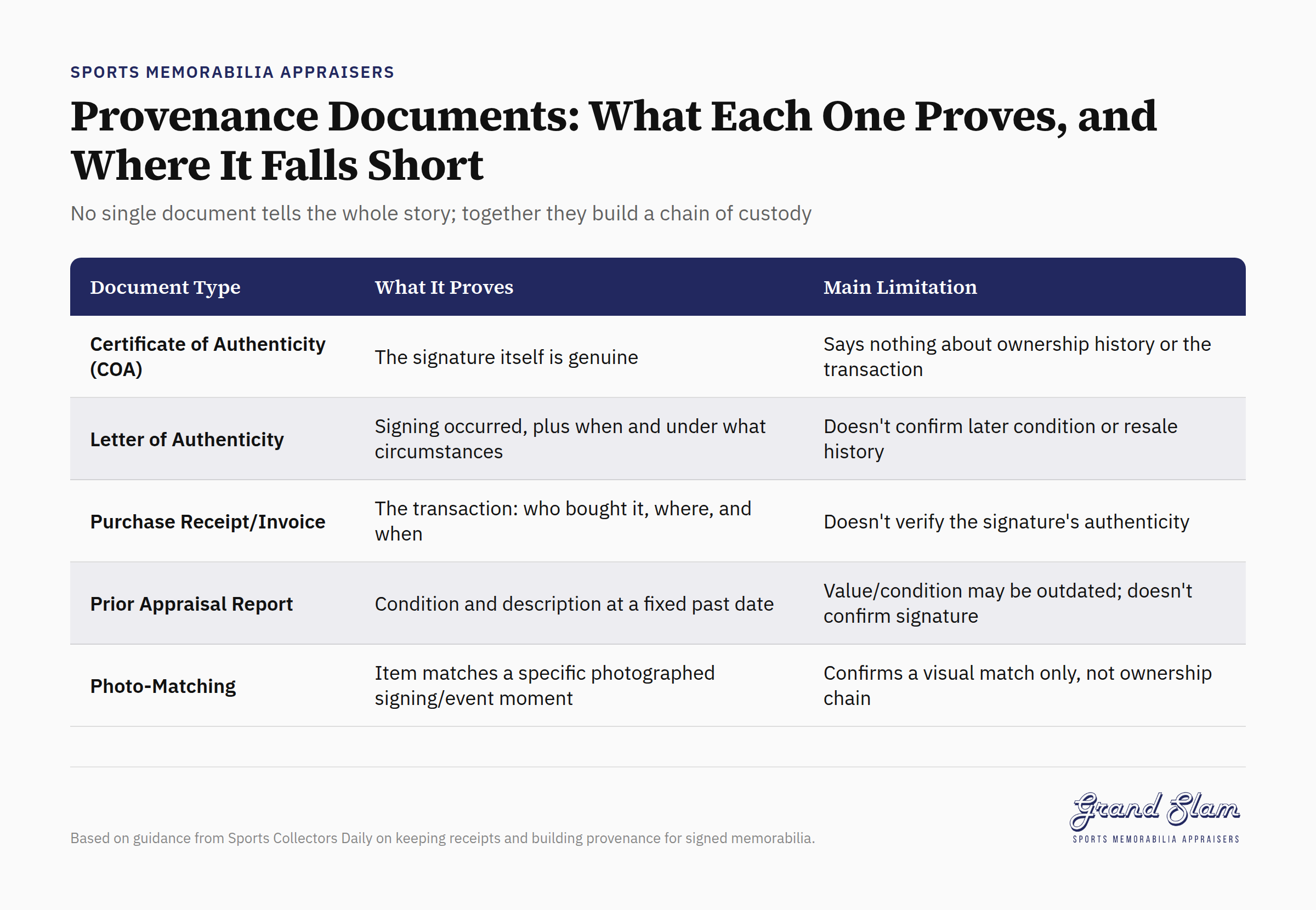
- Original purchase receipts or invoices from the team store, charity auction, or dealer where the item was first acquired.
- Letters from the athlete, team, or event organizer confirming the signing occurred, when, and under what circumstances.
- Prior appraisal reports that established a value and documented the item's condition and details at an earlier point in time.
- Auction house records of sale, including lot numbers, catalog descriptions, and settlement statements tying the item to a specific transaction.
Each of these fills a gap the others can't. A COA speaks to the signature. A receipt speaks to the transaction. A prior appraisal speaks to condition and description at a fixed date. Together, they build a chain of custody an appraiser, insurer, or buyer can actually follow.
Pro tip: keep digital copies of every document in a single folder, separate from the physical item. Fires, floods, and moves happen; the paper trail should survive even if the frame doesn't.
Why Provenance Matters for IRS Form 8283 Charitable Donations
When a signed jersey or ball is donated to charity and the claimed deduction exceeds $5,000, the IRS requires a qualified appraisal to support Form 8283. That appraisal has to include enough factual detail to stand on its own, which means the appraiser needs the acquisition history and authenticity support described above, not just a stated opinion of value.
This is also where donors most often trip up on evidence. List prices, dealer catalog prices, and offers to sell are not valid indicators of fair market value for a charitable donation, because they only document an offer, not a completed sale. An appraiser working toward a charitable donation appraisal needs actual comparable sales, ideally close in time to the donation date, plus the provenance file that supports the item's authenticity and description.
A donor who shows up with a signed ball, a vague story about where it came from, and a dealer's asking price from a website listing hasn't given the appraiser much to work with. A donor who shows up with a COA from a recognized authenticator, the original purchase receipt, and a photo-match report has given the appraiser a defensible foundation for the report the IRS will actually see.
Keep the File Before You Need It
Provenance documentation isn't something to assemble after a dispute starts, whether that's a denied insurance claim, a contested estate, or a challenged charitable deduction. The strongest position is having the COA, the receipts, the letters, and any photo-match evidence organized and ready before an appraiser ever opens the file. A jersey or ball with a thin, undocumented history will always appraise lower and defend less easily than the same item backed by a real paper trail.
Our appraisers regularly review COAs, provenance letters, and photo-matching reports as part of building sports memorabilia valuations for insurance, estate, and donation purposes. If you're not sure what's in your file or what's missing from it, that gap is worth closing before a claim, sale, or filing depends on it.
This article is provided for general informational purposes only and does not constitute legal, tax, or financial advice. Readers should consult a qualified attorney or CPA regarding their specific circumstances.