
Blog
Sports Memorabilia Charitable Donation Tax Deduction: What the IRS Actually Requires
A sports memorabilia charitable donation tax deduction over $5,000 requires a qualified appraisal and a signed Form 8283, and the IRS aggregates similar items so a whole collection can trigger the rule even if no single piece does. This guide walks through the thresholds, the appraiser qualifications, and the paperwork the deduction actually depends on.
Donating a signed jersey, a game-used bat, or a box of vintage trading cards to a charity feels like a simple, generous gesture. The IRS, however, treats it as a formal noncash contribution with its own paperwork, and once the claimed deduction crosses $5,000, the rules stop being optional. Getting a sports memorabilia charitable donation tax deduction approved on audit depends on a qualified appraisal, a properly signed Form 8283, and documentation that holds up months or years after the gift.
This guide walks through what the IRS actually requires: the dollar thresholds that change the paperwork, what makes an appraiser "qualified" in the eyes of the IRS, when the appraisal needs to be in hand, and the aggregation rule that quietly catches donors who give away a collection piece by piece. Our sports memorabilia appraisal for charitable donation work exists specifically because these rules leave no room for guesswork once real money is on the line.
The $5,000 Threshold: When a Qualified Appraisal Kicks In
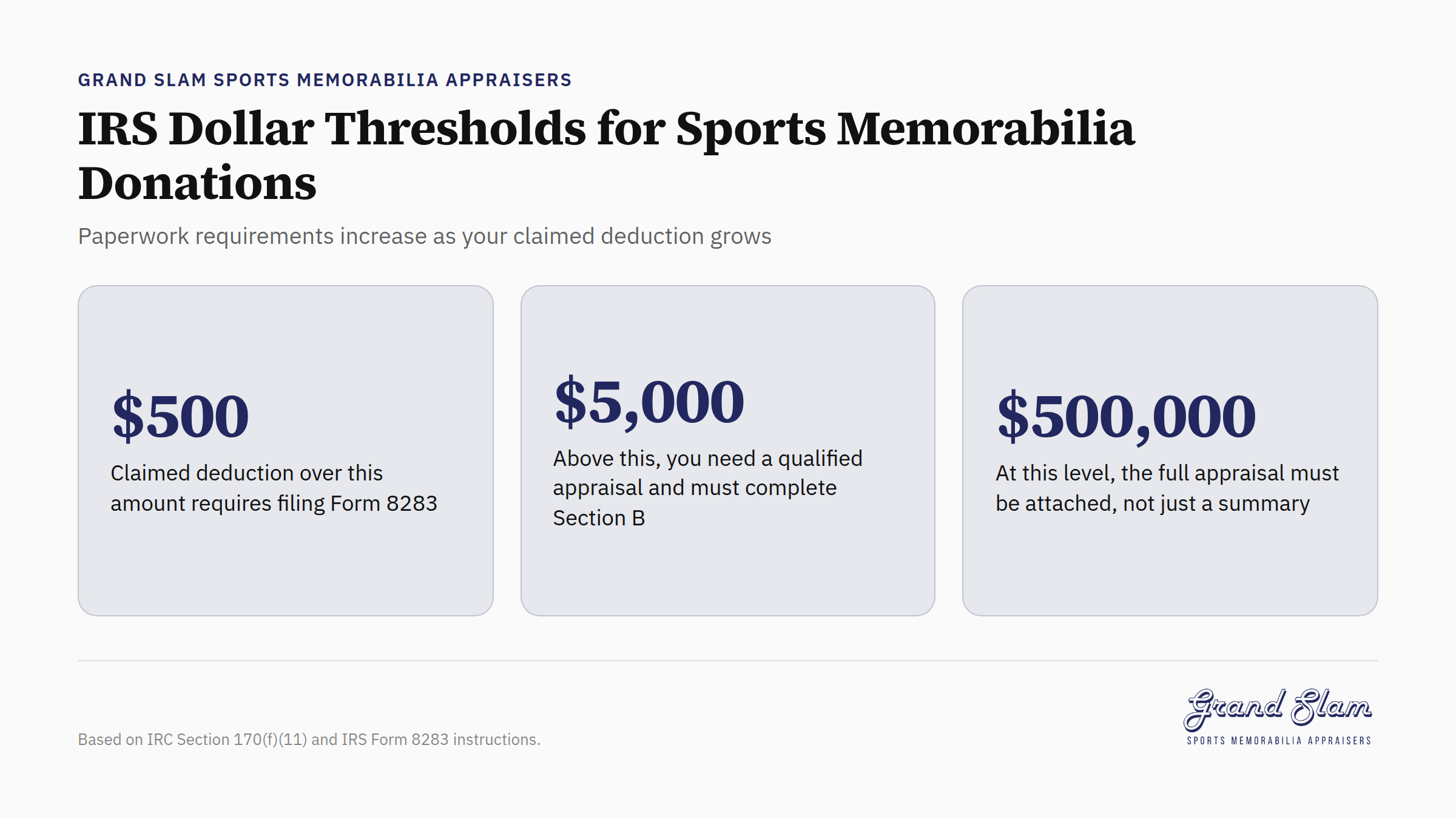
A claimed deduction of more than $500 for donated memorabilia requires you to file Form 8283 with your return. Once the claimed deduction for an item, or a group of similar items, exceeds $5,000, you generally need a qualified appraisal from a qualified appraiser and must complete Section B of that form. If the deduction reaches $500,000, the IRS requires you to attach the full appraisal itself, not just the summary.
This structure comes directly from IRC Section 170(f)(11), which conditions the deduction on obtaining a qualified appraisal and reporting the required information for any property contribution claimed above $5,000. The IRS does not carve out a separate category for sports memorabilia. Autographed jerseys, game-used equipment, signed balls, and trading cards are all treated under the general rules for collectibles and tangible personal property.
What Makes an Appraiser "Qualified" Under IRS Rules
An appraiser is only "qualified" for IRS purposes if they meet specific, checkable criteria, not just because they call themselves an expert. Under Treasury Regulation 1.170A-17, a qualified appraiser must have verifiable education and experience valuing the specific type of property being donated, must regularly perform appraisals for compensation, and must not fall into any of the categories the IRS excludes from the role.
Excluded parties generally include the donor, the donee organization, anyone who prepared the property for sale, anyone who sold the item to the donor within the prior two years for a purpose relevant to the appraisal, and anyone related to those parties. For a memorabilia collection, that means the auction house that sold you the jersey and the charity receiving it cannot also serve as the appraiser.
A few additional rules apply to every qualified appraisal regardless of asset type:
- The appraisal must be signed and dated by the appraiser.
- It must conform to generally accepted appraisal standards and describe the methodology used to reach the value.
- The appraiser cannot charge a fee based on a percentage of the appraised value, a structure the IRS treats as a red flag on its own.
- The valuation effective date must fall no earlier than 60 days before the contribution and no later than the contribution date itself, per the IRS guidance on determining value.
Timing: The Appraisal Doesn't Have to Predate the Gift
A common misconception is that the appraisal must be completed before the memorabilia leaves your hands. It doesn't. What matters is that the qualified appraisal is in hand by the due date of the return on which you claim the deduction, including any extensions you file. The valuation date itself has to sit inside that 60-day window around the contribution, but the physical report can be prepared afterward, as long as it's ready well before you file.
In practice, that means a donor who gives a jersey collection in November has until the following April, or October with an extension, to secure the report. Waiting that long is risky, though. Appraisers need time to research comparable sales, and if authenticity questions come up during research, resolving them late in the process can jeopardize your filing timeline.
Completing Form 8283 Section B: Three Signatures, One Form
Section B of Form 8283 requires input from three separate parties, and missing any one of them can invalidate the deduction. The form is built around a description of the property, a declaration from the appraiser, and an acknowledgment from the receiving organization:
- Part I: You describe the donated memorabilia in enough detail to identify it (the player, the item type, date acquired, and how you acquired it), along with the appraised fair market value.
- Part II, Declaration of Appraiser: The appraiser signs, certifying their qualifications and confirming they understand the penalty for a substantial or gross valuation misstatement.
- Part III, Donee Acknowledgment: The charity signs, confirming it received the item described. This section does not certify the value; it only confirms receipt.
If the charity sells or otherwise disposes of the memorabilia within three years of the gift, it's generally required to file a separate donee information return with the IRS, which is one more reason the initial description on Form 8283 needs to be precise.
The "Similar Items" Aggregation Rule for Memorabilia Collections
The IRS aggregates similar items of donated property when applying the dollar thresholds, and this is where memorabilia collectors most often get caught off guard. If you donate three autographed jerseys in the same tax year, even to three different charities or on three different dates, the IRS treats them as one group for purposes of the $5,000 and $20,000 thresholds.
Example: A collector donates a game-worn jersey valued at $2,200, a signed baseball valued at $1,800, and a rookie card graded and valued at $2,500, all within the same calendar year. No single item crosses $5,000 on its own, but the combined $6,500 does. A qualified appraisal and Section B of Form 8283 are required for the group, not optional just because each item is individually modest.
This aggregation applies within a category of similar property (memorabilia and collectibles), not across unrelated donations. A separate donation of household furniture in the same year would be assessed on its own.
The $20,000 Trigger: When You Must Attach the Full Appraisal
Once a claimed deduction for a memorabilia collection reaches $20,000, the IRS generally wants the complete qualified appraisal attached to the return, not just the Form 8283 summary. High-resolution photographs of the individual pieces, showing condition, signatures, and any identifying marks, are also recommended at this level, and the IRS can request them even if they weren't attached originally.
Collectors with a genuinely valuable holding, several signed jerseys from a Hall of Fame career, a complete graded card set, or a run of game-used bats, should expect this level of documentation as standard practice rather than an unusual burden.
Authentication Is Not the Same as Appraisal
A letter of authenticity from a firm like PSA/DNA or JSA confirms that a signature or a piece of equipment is genuine. It says nothing about what the item is worth. Photo-matching a jersey to a specific game, verifying provenance through a chain of custody, and grading a card's condition are all steps that feed into a valuation, but they are not a substitute for the qualified appraisal itself.
Value drivers for sports memorabilia (the strength of the autograph, game-worn provenance, photo-match documentation, rarity within a set, and condition grade) belong in the appraiser's analysis, not on the authentication certificate. A donor who submits a PSA/DNA letter alone in place of an appraisal for a $12,000 jersey collection has not satisfied the IRS requirement, regardless of how solid the authentication is.
Worked Example: Donating a Collection of Autographed Jerseys and Cards
Consider a donor giving a mixed collection to a university athletics foundation in the same tax year.
| Item | Description | Claimed Value |
|---|---|---|
| Jersey 1 | Game-worn, photo-matched, single-signed | $4,500 |
| Jersey 2 | Signed, unworn, limited edition | $2,800 |
| Card lot | 12 graded rookie cards, mixed grades | $3,200 |
| Signed ball | Single-signed, PSA/DNA letter | $1,100 |
| Total | $11,600 |
Because these are similar items donated in the same year, the IRS aggregates them, and the group total of $11,600 sits well above the $5,000 threshold even though the signed ball alone would never trigger the rule. The donor needs one qualified appraisal covering the full group, a completed Section B on Form 8283 with the appraiser's signature and the university's acknowledgment, and records supporting each item's authenticity kept alongside the appraisal. None of the individual pieces reaches $20,000, so the full report doesn't need to be attached to the return, but it must still exist and be available if the IRS asks for it.
What a Sports Memorabilia Appraisal Costs
Appraisal fees for sports memorabilia are quoted as a fixed fee after the collection is scoped, never billed by the hour and never tied to the appraised value itself (a percentage-based fee arrangement is one the IRS explicitly disallows for qualified appraisals). Standard reports for sports memorabilia generally start at $195, and IRS-qualified reports suitable for a charitable deduction generally start at $295. Typical engagements for a modest collection run $395 to $2,200, while larger or more complex collections, multiple graded sets, extensive game-worn provenance research, or high-value single items, can run $1,600 to $5,000 or more.
What drives the fee is the scope of the work: how many items are in the collection, how much research the appraiser needs to do to support each value, and whether the report needs to meet IRS qualified-appraisal standards. The eventual dollar value of the jersey or card doesn't change what the appraisal costs to produce.
Protect Your Deduction Before You File
The paperwork behind a sports memorabilia charitable donation tax deduction is unforgiving in one specific way: there's no fixing a missing appraisal or an unsigned Form 8283 after the IRS has already flagged the return. Donors who plan ahead, get the appraisal from a qualified appraiser, aggregate similar items correctly, and keep authentication separate from valuation rarely have trouble defending the deduction. Donors who skip the appraisal because "it's just a signed ball" are the ones who end up losing it.
If you're planning to donate autographed jerseys, game-used equipment, signed balls, or a card collection this year, request an appraisal before you finalize the gift so the valuation date and the paperwork line up the way the IRS expects.
This article is provided for general informational purposes only and does not constitute legal, tax, or financial advice. Readers should consult a qualified attorney or CPA regarding their specific circumstances.