
Blog
How Much Does a Sports Memorabilia Appraisal Cost to Prepare?
A sports memorabilia appraisal cost depends on collection size, authentication complexity, and whether the report must meet IRS-qualified standards. This guide breaks down the fee structures collectors actually encounter and what pushes the price up or down.
Collectors asking about sports memorabilia appraisal cost usually have one item in mind, a signed jersey, a graded rookie card, a World Series ring, and expect a single number back. The honest answer is that cost depends on scope: how many items, how much authentication research each one requires, and what the report needs to accomplish. This guide walks through the fee structures collectors actually run into, what drives a quote higher, and what keeps it modest.
What Actually Determines a Sports Memorabilia Appraisal Cost?
An appraisal fee is set by the scope of the assignment, not by what the item is ultimately worth. The main scope factors are the number of items in the collection, the depth of authentication and provenance review each piece requires, the number of physical locations the appraiser must visit (if any), the number of distinct item categories involved (cards, jerseys, autographs, and equipment each require different comparable-sales research), and whether the report must meet IRS-qualified standards or a less formal insurance or estate standard.
A single graded card with a clean chain of custody takes far less time to value than a 200-piece collection spanning six sports, multiple eras, and several autograph authenticators. Our charitable donation appraisal service and our insurance coverage appraisal service both start with the same scoping conversation: what's in the collection, what documentation already exists, and what the report needs to support.
Fee Structures Collectors Actually Encounter
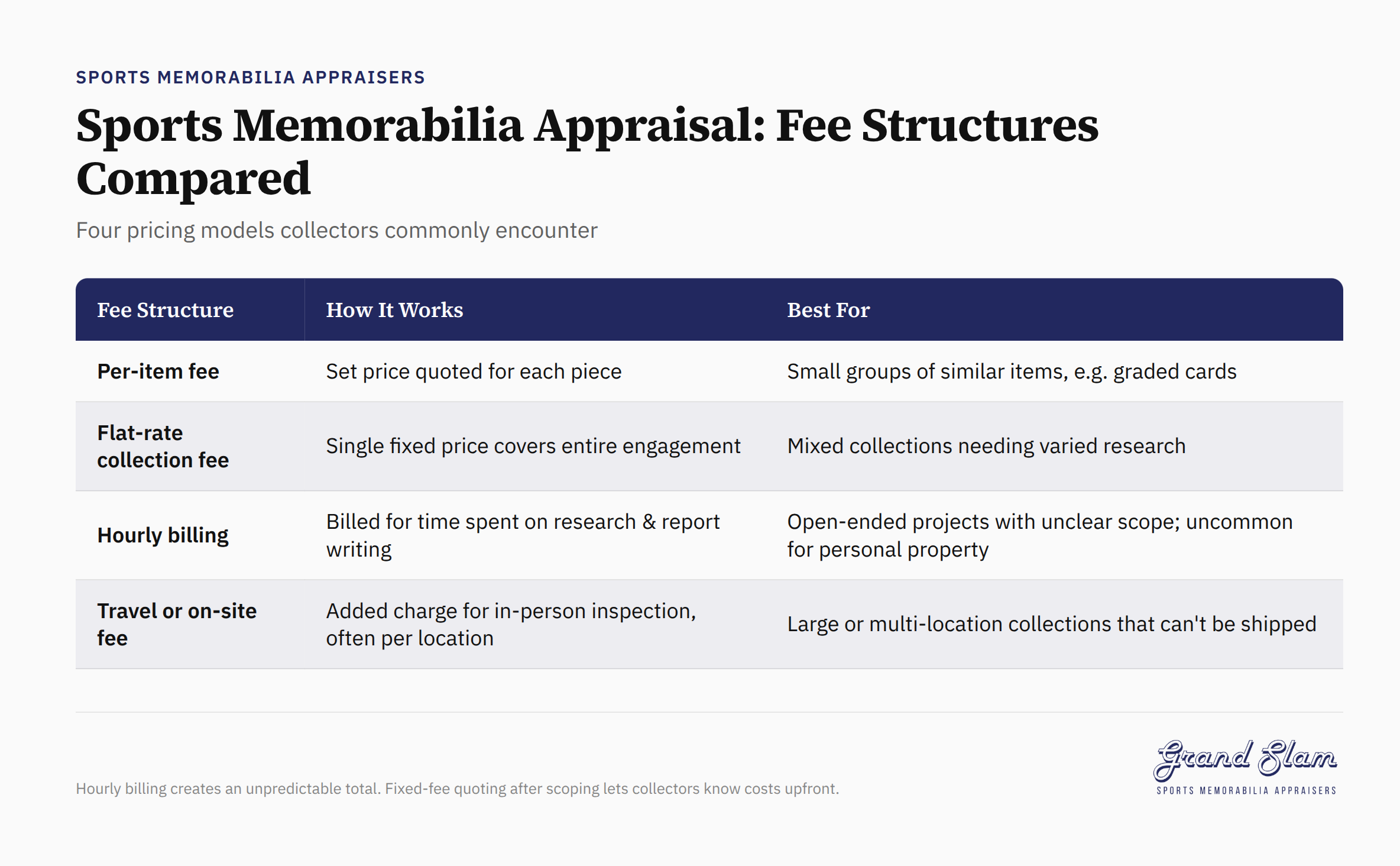
Across the collectibles appraisal industry, four basic fee structures show up again and again. Each one fits a different kind of assignment.
| Fee Structure | How It Works | Best For |
|---|---|---|
| Per-item fee | A set price is quoted for each piece in the collection | Small groups of similar items, like a handful of graded cards |
| Flat-rate collection fee | A single fixed price covers the entire engagement | Mixed collections where some items need more research than others |
| Hourly billing | The appraiser bills for time spent on research and report writing | Open-ended projects with unclear scope; uncommon for personal property work |
| Travel or on-site fee | An added charge for in-person inspection, often per location | Large collections that can't be shipped, or items split across multiple homes |
Hourly billing is worth flagging because it creates an unpredictable total, a collector has no way to know the final number until the work is done. We quote every engagement as a fixed fee after scoping the assignment, so collectors know the total cost before any research begins.
What Pushes a Sports Memorabilia Appraisal Cost Up
A few factors reliably increase the fee, and all of them trace back to the amount of research and documentation the report requires.
- Collection size: More items mean more individual identification, condition assessment, and comparable-sales research, even when the appraiser can spread some reporting costs across the group.
- Authentication complexity: Autographs, game-used equipment, and ungraded cards often require specialist review to rule out alterations, reprints, or counterfeit risk.
- Missing provenance: A documented chain of ownership, team letters, or auction history shortens research time. Without it, the appraiser has to reconstruct the item's history from scratch.
- Multiple locations: Collections stored across several homes or storage units add travel time and coordination to the assignment.
- Distinct item categories: A collection spanning cards, jerseys, tickets, and autographs touches several different comparable-sales markets, each requiring its own research.
- IRS-qualified reporting: A report built to satisfy a charitable donation deduction or estate filing involves more documentation than an informal insurance estimate, including a signed appraiser declaration and a defined valuation date.
What Keeps the Cost Down
On the other end, several things reliably keep a quote modest. A single item with a clear, well-documented history is the simplest case. Graded cards from major grading services come with an established condition baseline already attached, which cuts down on the appraiser's own condition assessment. Photo-based remote review, where the collector supplies clear images and an item inventory upfront, lets the appraiser complete much of the research before any in-person contact is needed. And a simple written inventory list, organized by category with purchase dates and any existing documentation, saves real time compared to an appraiser building that list from scratch during inspection.
Pro tip: Before requesting a quote, pull together whatever documentation already exists, authentication certificates, purchase receipts, grading slabs, prior insurance schedules. The more complete the file, the tighter the fee estimate will be.
Our Published Pricing for Sports Memorabilia Appraisals
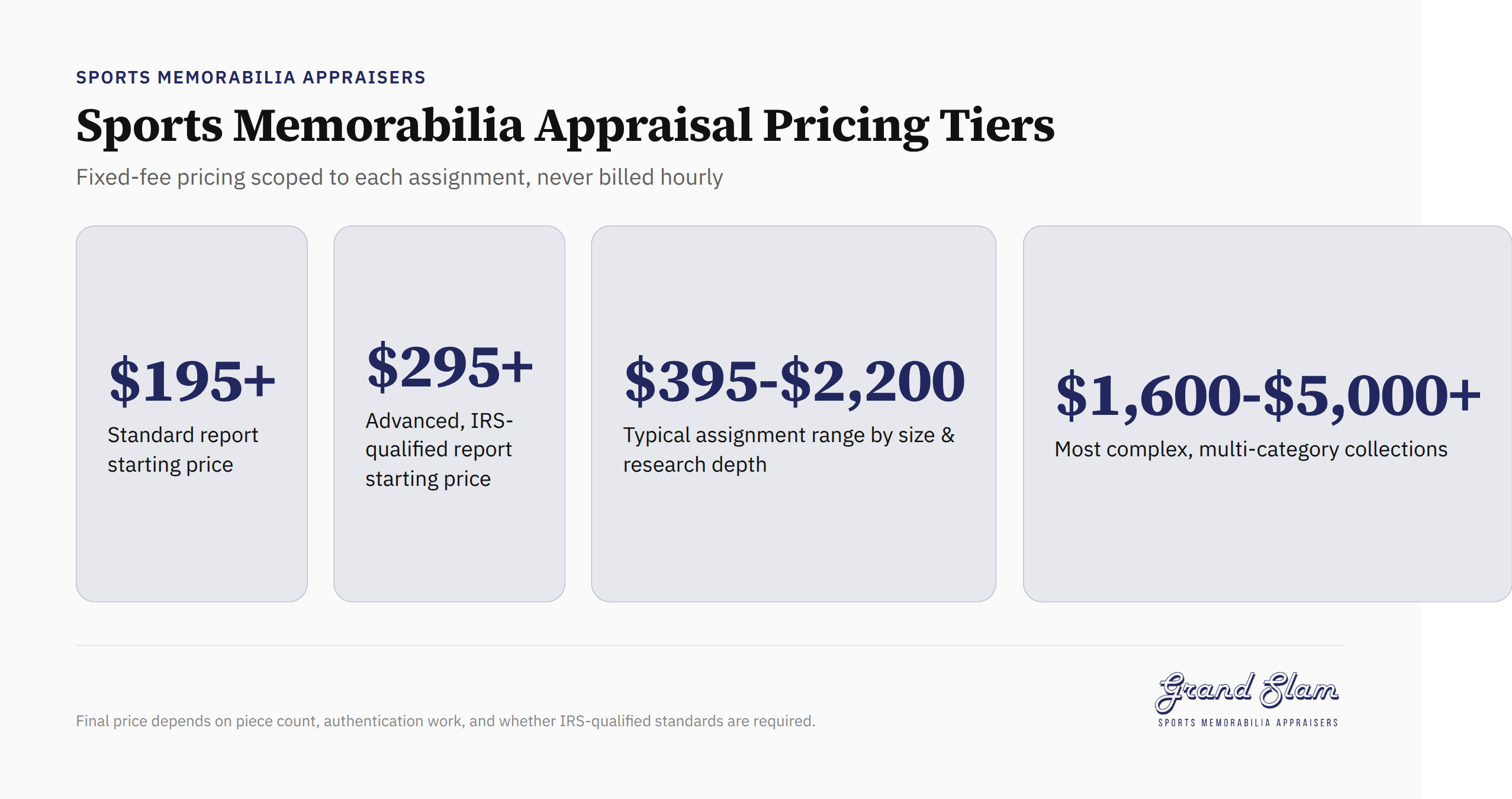
Our sports memorabilia appraisal fees are quoted as a fixed price after we scope the assignment, never billed by the hour. Standard reports start at $195, and advanced, IRS-qualified reports start at $295. Typical assignments run $395 to $2,200 depending on collection size and research depth, and the most complex collections, those spanning many categories or requiring extensive authentication, run $1,600 to $5,000 or more.
Where a given assignment falls in that range comes down to the scope factors above: how many pieces, how much authentication work, and whether the report needs to meet IRS-qualified standards for a donation or estate filing.
IRS-Qualified Appraisals and a Different Kind of IRS Fee
When a donated item or group of similar items is claimed at more than $5,000, the donor generally needs a qualified appraisal and must complete Section B of IRS Form 8283, including a donee signature. The appraisal must be signed no earlier than 60 days before the donation date, and the IRS is explicit that an appraisal fee can never be based on a percentage of the appraised value, which is part of why fixed, scope-based pricing is standard across the industry.
It's worth distinguishing this from a completely separate IRS process that collectors sometimes confuse with appraisal pricing: the Statement of Value. This is a pre-filing review service the IRS offers for donated art, and per IRS Publication 561, it carries its own user fee of $8,400 for one to three items plus $800 for each additional item. That fee has nothing to do with what an appraiser charges to prepare a report; it's a fee the IRS charges to review and pre-approve a submitted appraisal of art specifically, not sports memorabilia, and not a fee our appraisers charge for any engagement.
Credentials and Standards Behind the Report
A defensible sports memorabilia appraisal is prepared in accordance with USPAP (the Uniform Standards of Professional Appraisal Practice, published by The Appraisal Foundation), and our appraisers hold credentials with organizations including the ISA, ASA, and AAA. The International Society of Appraisers notes that its credentialing path requires appraisers to complete formal training in valuation methodology and report writing, not just item identification, which is part of why a qualified report costs more to produce than an informal price check.
The report itself typically documents physical inspection and condition, authentication and provenance review, research into comparable sales (often including documented auction results for materially similar items), and a stated valuation conclusion tied to a specific effective date and intended use. That's the work the fee is paying for, whether the engagement covers a single signed ball or a 150-piece estate collection.
Getting an Accurate Quote
The fastest way to get a reliable number is to describe the collection as completely as possible before the first call: item count, categories, existing documentation, and the intended use (insurance, estate, divorce, or charitable donation). Our team scopes the assignment against that information and returns a fixed fee before any work begins, so there are no surprises once the report is in hand. For collections tied to a donation or an estate filing, our probate appraisal service walks through the specific documentation those reports require.
If you're ready to see what your collection would cost to appraise, you can request an appraisal and our team will scope the assignment and quote a fixed fee.
This article is provided for general informational purposes only and does not constitute legal, tax, or financial advice. Readers should consult a qualified attorney or CPA regarding their specific circumstances.