
Blog
What the Qualified Appraiser Must Sign on Form 8283 for Sports Memorabilia Donations
When a donated sports memorabilia collection triggers Section B of IRS Form 8283, the qualified appraiser's signature is a sworn declaration, not a formality. Here is exactly what the appraiser certifies, what the appraisal report must contain, and what happens if the numbers are wrong.
A signed jersey, a game-used bat, or a vintage card collection can carry real tax consequences once it leaves your hands and goes to a museum, university, or charitable foundation. If the claimed deduction for that memorabilia exceeds $5,000, the donor cannot simply estimate a number and move on. Section B of IRS Form 8283 has to be completed, a qualified appraiser has to sign a sworn declaration, and the appraisal itself has to meet specific federal content requirements. This article focuses narrowly on that mechanic: who signs Section B, what the appraiser is actually certifying, what the appraisal report must contain, and what penalties an appraiser faces for getting the value wrong.
If you need the broader picture of donation thresholds, aggregation rules, and how the deduction works end to end, our sports memorabilia charitable donation tax deduction guide covers that ground. This piece goes deeper into the signature itself.
When Does a Sports Memorabilia Donation Require Section B?
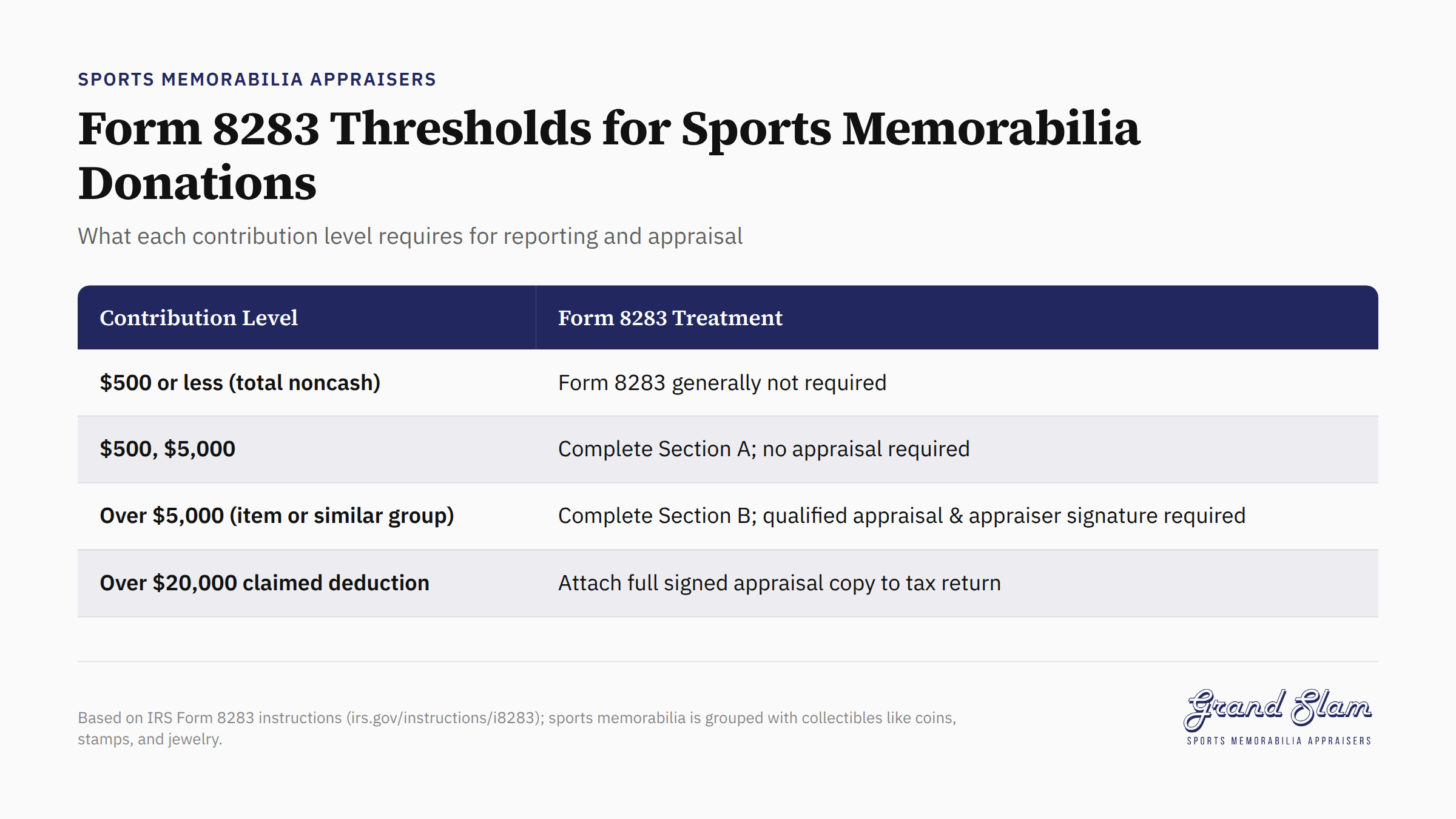
Form 8283 is generally required once a taxpayer's total noncash charitable contributions for the year exceed $500, but Section B only comes into play at a higher threshold. If the claimed deduction for a single item, or a group of similar items donated to the same organization, exceeds $5,000, the donor must complete Section B and generally obtain a written qualified appraisal, according to the IRS Form 8283 instructions. The IRS specifically groups sports memorabilia with other collectibles such as coins, stamps, books, and jewelry for this purpose.
| Contribution level | Form 8283 treatment |
|---|---|
| $500 or less in total noncash contributions | Form 8283 generally not required |
| More than $500 but not more than $5,000 | Complete Section A; no qualified appraisal required |
| More than $5,000 for an item or group of similar items | Complete Section B; qualified appraisal and appraiser signature generally required |
| More than $20,000 claimed deduction | Attach a complete copy of the signed appraisal to the return |
Example: A donor gives a game-used jersey appraised at $3,200 and a separate set of autographed baseballs appraised at $2,100 to the same museum in the same year. Treated as similar items for Section B purposes, the combined claimed deduction of $5,300 exceeds $5,000, so Section B applies to the group even though neither item alone crosses the line.
Who Must Complete Section B, Part III: The Declaration of Appraiser
The qualified appraiser, not the donor and not the charity, completes and signs Part III of Section B. This is the Declaration of Appraiser, and it is a sworn statement made under penalties of perjury, not a routine signature line.
The appraiser's declaration requires several specific affirmations. The appraiser must state that they are qualified to value the type of property contributed, that the appraisal was prepared for income tax purposes, and that they understand the consequences of a substantial or gross valuation misstatement under the federal appraiser penalty rules. The appraiser must also disclose identifying information to make the declaration enforceable:
- Full name and business address.
- Taxpayer identification number.
- A statement of the appraiser's qualifications: education, professional experience, and relevant credentials.
- Signature and date signed.
Our appraisers who handle sports memorabilia engagements typically hold credentials with organizations such as the ASA, ISA, and AAA, and every report is prepared in accordance with USPAP. That credential disclosure is exactly what Part III asks the appraiser to document: the appraiser is certifying, on the record, that they are qualified for this specific category of property.
Watch out: A person who regularly sells or deals in the type of memorabilia being donated can still serve as the appraiser in many cases, but certain relationships disqualify a person outright, including the donor, the donee organization, a party to the transaction, and anyone whose closeness to the donor or donee would reasonably call independence into question.
What the Appraiser's Signature Actually Certifies
Signing Part III is not an acknowledgment that a document exists. It is the appraiser's certification that the appraisal meets the federal definition of a qualified appraisal and that the appraiser meets the qualified appraiser standard. The IRS Form 8283 instructions require the appraiser to affirm, among other things, that their compensation for the appraisal was not based on a percentage of the appraised value.
That last point matters more for memorabilia than it might seem. An appraiser who is paid a cut of the eventual sale, or whose fee scales with the number assigned to the collection, cannot sign a compliant declaration. Our engagements are quoted as a fixed fee before work begins, scoped to the collection itself, never tied to the concluded value.
Key takeaway: The appraiser's Part III signature is a professional certification with legal weight. It tells the IRS that a qualified, independent expert stands behind both the valuation methodology and the number itself.
The donee organization's role is separate and should not be confused with the appraiser's. The charity signs Part IV, the Donee Acknowledgement, which confirms the organization received the described property. That signature does not mean the charity agrees with the appraised value; it is a receipt, not an endorsement, per the IRS Form 8283 instructions.
What the Appraisal Report Itself Must Contain
Form 8283 is only a summary. The actual qualified appraisal is a separate, more detailed document that the appraiser prepares and the taxpayer keeps on file. Treasury regulations and IRS Publication 561 describe what that underlying report needs to cover, and the requirements are specific enough that a generic valuation letter will not satisfy them.
A compliant sports memorabilia appraisal report generally needs to address the following:
- A detailed description of the item: the player, team, manufacturer, year, edition, and any identifying markings that distinguish it from similar pieces.
- Authentication and condition: grading information, signature verification, and any certificates from recognized authenticators.
- Provenance: the ownership history supporting the item's authenticity and value.
- The valuation date: generally the date of the contribution, consistent with the timing rules in the appraisal.
- The valuation method and comparable sales: the market data and reasoning used to reach the concluded value, with adjustments explained.
- The appraiser's qualifications and signature: matching the declaration made on Form 8283 itself.
For collections where authenticity is central to value, documenting provenance is often the single biggest driver of a defensible report. Our guide on provenance documentation for signed jerseys and game-used equipment walks through what that paper trail should look like.
The appraisal must also be timed correctly. It generally needs to be completed no earlier than 60 days before the donation and received by the donor no later than the due date, including extensions, of the return on which the deduction is first claimed, under the rules described in IRS Publication 561.
The $20,000 Rule: When the Full Appraisal Must Be Attached
For most donations above $5,000, the taxpayer completes Form 8283 and keeps the full qualified appraisal on file without attaching it to the return. That changes once the claimed deduction exceeds $20,000. At that level, the taxpayer should attach a complete copy of the signed appraisal to the return, not just the Form 8283 summary, according to IRS Publication 561.
This rule was written with high-value art donations in mind, but it applies by claimed-value amount, not by asset category. A rare, high-grade rookie card collection or a museum-quality game-worn uniform that appraises above $20,000 falls under the same attachment requirement as a painting. If the item independently meets the tax definition of art, additional Art Appraisal Services review procedures described on the IRS Art Appraisal Services page can apply as well, though most sports memorabilia is evaluated as a collectible rather than fine art.
Pro tip: If a collection's combined value is approaching $20,000, confirm with your preparer whether the full appraisal needs to be attached before the return is filed. Missing this step can delay processing even when the valuation itself is sound.
Appraiser Penalty Exposure Under IRC 6695A
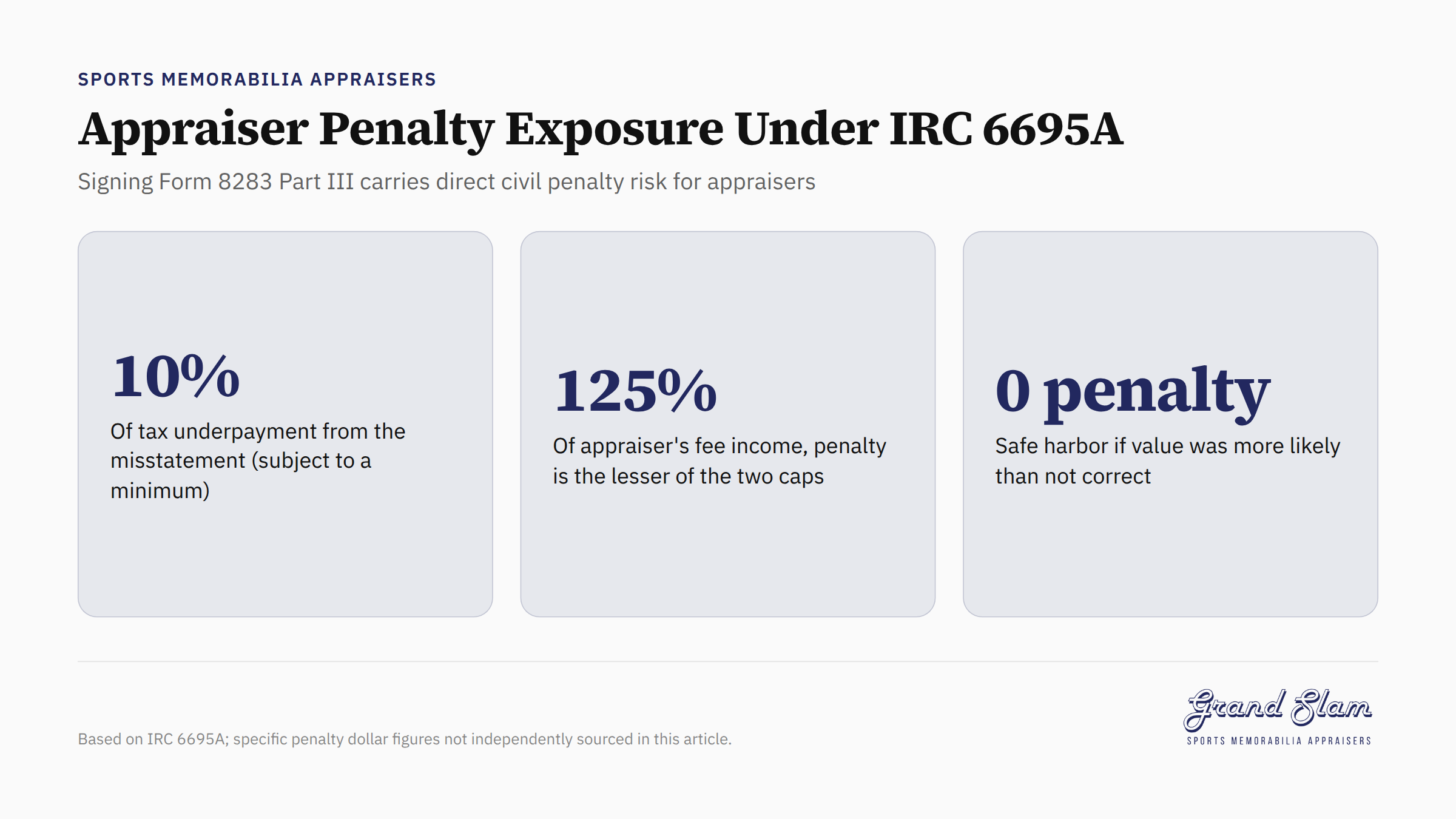
An appraiser who signs Part III is putting more than a reputation on the line. Under IRC 6695A, an appraiser who prepares an appraisal connected to a substantial or gross valuation misstatement can face a direct civil penalty, separate from any penalty assessed against the donor.
A substantial valuation misstatement generally occurs when the claimed value is significantly higher than the amount later determined to be correct, and a gross valuation misstatement is an even larger overstatement. The penalty amount is generally the lesser of 10% of the tax underpayment attributable to the misstatement (subject to a minimum) or 125% of the gross income the appraiser received for preparing the appraisal.
There is a narrow safe harbor: no penalty applies if the appraiser can establish that the appraised value was more likely than not correct. Separately, an appraiser who knowingly or fraudulently overstates a property's value may also face civil penalties for aiding and abetting an understatement of tax liability, and the IRS may disregard that appraiser's reports going forward.
This is one reason the qualification language in Part III is not boilerplate. An appraiser who signs without the background to value sports memorabilia accurately is exposed to penalties that exist specifically to deter inflated donation values.
Getting the Declaration Right the First Time
Section B of Form 8283 asks for more than a signature; it asks a qualified appraiser to put their credentials and compensation structure on record and stand behind the number. For sports memorabilia, where authentication, grading, and provenance drive most of the value, a report that skips these details invites IRS scrutiny even when the underlying valuation is reasonable.
Our team prepares USPAP-compliant appraisals for signed jerseys, game-used equipment, and card collections, with the documentation Section B requires built into every report. If you are planning a memorabilia donation above the $5,000 threshold, our sports memorabilia appraisal for charitable donation service is built around exactly this process.
This article is provided for general informational purposes only and does not constitute legal, tax, or financial advice. Readers should consult a qualified attorney or CPA regarding their specific circumstances.