
Blog
Donating Sports Tickets to Charity: A Fan's Guide to the Appraisal Rules
Deciding whether to donate season tickets, a playoff pair, or a luxury suite involves more than picking a charity: it means knowing when a qualified appraisal and a written acknowledgment are both required. This guide walks fans through choosing a recipient, valuing tickets at resale price, and timing the gift so it actually counts as a deduction.
A season-ticket holder sitting on a stack of unused games. A fan who scored a pair of tickets to a rivalry game they can't attend. A company with a luxury suite going unused for a playoff run. All three are facing the same question: does it make more sense to sell these tickets, let them go to waste, or donate them to charity and claim a deduction?
The answer depends less on the sport and more on the paperwork. Once you decide to donate, the value of what you're giving away determines whether a simple receipt will do or whether you need a formal, USPAP-compliant appraisal. Our sports memorabilia appraisal for charitable donation service exists precisely for this gap: fans and organizations who want a defensible valuation before they file. This guide walks through the actual decisions involved, starting with who should receive the tickets in the first place.
Who Can Receive Your Donated Tickets
A charitable deduction only exists if the recipient is a qualified organization, typically one recognized as a 501(c)(3) public charity. Fans looking to donate tickets generally choose from a handful of proven recipient types:
- School booster clubs and athletic departments, which often auction game tickets to raise funds for equipment or travel.
- Youth sports leagues and community athletic programs, which use donated pro tickets as raffle prizes or reward incentives.
- Military and veterans' service organizations, many of which run dedicated ticket-donation drives tied to specific games.
- Hospital patient and pediatric programs, which distribute tickets directly to patients and families.
- Official team or league charity ticket-donation programs, run through a franchise's own foundation.
Before you commit tickets to any of these, confirm the organization's tax-exempt status. The IRS overview of charitable contribution rules is a useful starting point for understanding what counts as a qualified organization and what doesn't. A donation to an informal fundraiser or a for-profit group, however worthy the cause feels, will not generate a deduction no matter how the tickets are valued.
The Two Documents You Actually Need
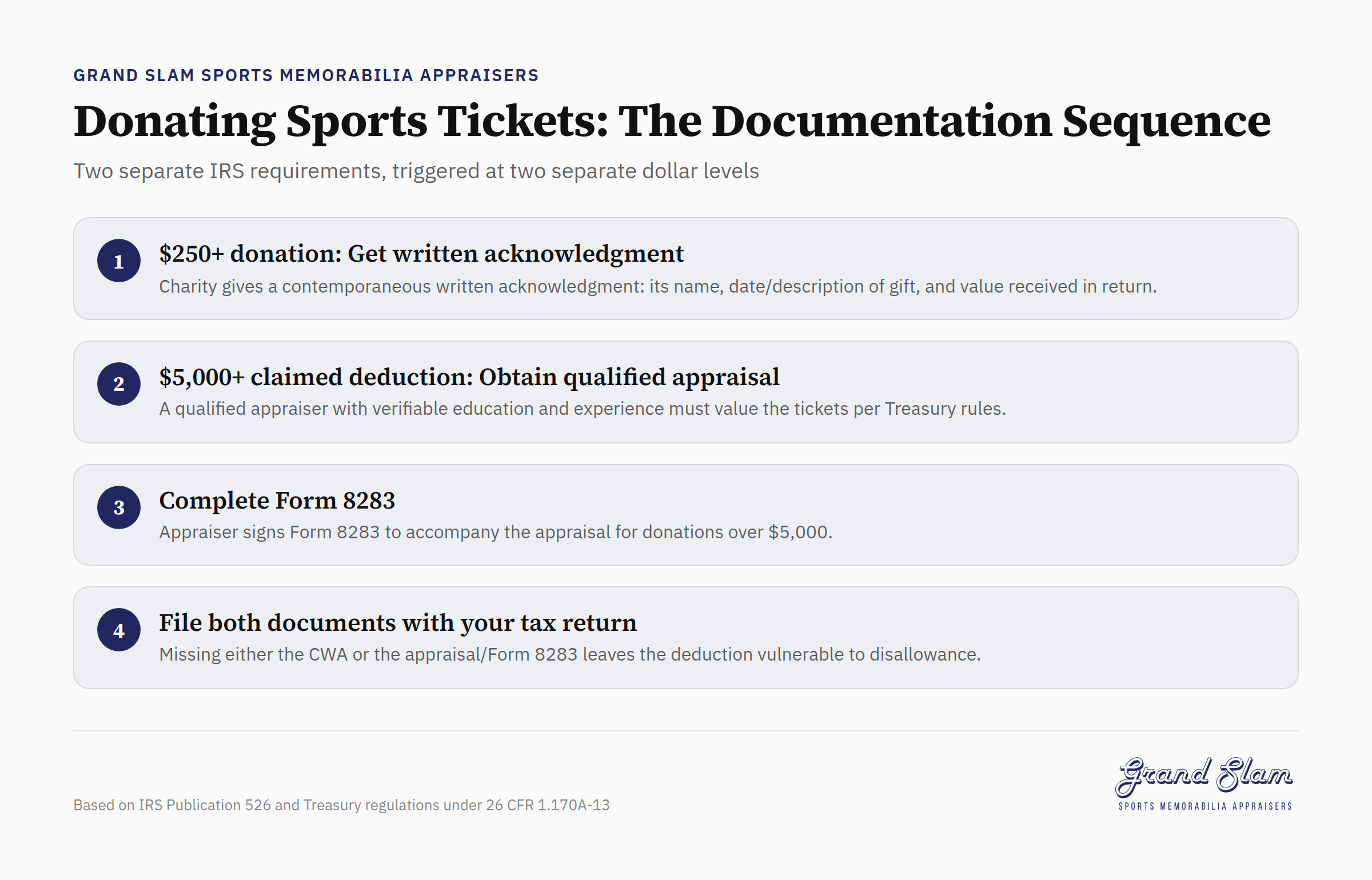
Many fans assume that once they clear the appraisal threshold, the appraisal itself is the only paperwork that matters. It isn't. Two separate requirements apply, triggered at two separate dollar levels, and donors need both.
Watch out: A qualified appraisal without a written acknowledgment from the charity, or a written acknowledgment without an appraisal above $5,000, is not sufficient on its own. The IRS treats them as independent requirements.
For any single donation of $250 or more, the charity must provide you with a contemporaneous written acknowledgment (CWA). Under the rules described in IRS Publication 526, that acknowledgment has to include the organization's name, the date and description of what was donated, and a statement about whether you received anything of value in return. This applies even to a single ticket pair worth $300; it has nothing to do with the $5,000 appraisal threshold.
Separately, once your claimed deduction for a ticket or a group of similar tickets exceeds $5,000, you need a qualified appraisal prepared by a qualified appraiser, someone with verifiable education and experience valuing this type of property, along with a completed Form 8283 signed by that appraiser. The definition of what counts as a qualified appraisal, including timing and content requirements, is spelled out in the Treasury regulations governing charitable contribution substantiation. Additional detail on what qualifies someone to prepare that appraisal is available through public guidance on qualified appraiser standards. Miss either document and the deduction is vulnerable to disallowance, regardless of how legitimate the gift was.
Season Tickets, Playoff Strips, and Single-Game Pairs
How your tickets get grouped matters as much as their individual value. A single pair to one game is evaluated on its own. But a block of season tickets, or a run of playoff games donated together, is generally treated as one group of similar items for purposes of the $5,000 appraisal threshold. That means a season-ticket holder who donates several mid-tier games across a season can trigger the appraisal requirement even though no single game, by itself, would have crossed the line.
This grouping concept trips up more donors than the dollar threshold itself. If you're donating multiple tickets to the same charity over the course of a season, add up the fair market value of the whole batch before assuming you're in the clear. Fans who have already navigated this with a single high-value item, like a rare vintage ticket stub, will recognize the same logic; our guide on how to appraise a vintage sports ticket stub for charitable donation walks through that scenario in more depth.
The PSL Trap: When Your Seat Isn't Really Yours to Give
Not every seat comes with something you can hand over. Personal seat licenses (PSLs) and other non-transferable ticket rights are tied contractually to the license holder, and in many cases the underlying right isn't freely transferable property at all. If your seating arrangement includes a PSL, or the tickets are subject to a use restriction that prevents you from assigning them to someone else, you may not actually be conveying deductible property when you "donate" the game tickets tied to that license.
This gets more complicated if you retain any benefit, such as keeping your seating priority or renewal rights for future seasons while only giving away access to a single game. A retained benefit can reduce or eliminate the deduction, because you haven't fully parted with the asset. This is a genuine gray area, not a blanket rule, so confirm the transferability of your specific ticket agreement before assuming a deduction is available. A conversation with the team's ticket office or your own tax advisor before the donation, not after, will save you from an unpleasant surprise at filing time.
How Fair Market Value Is Set for a Donated Ticket
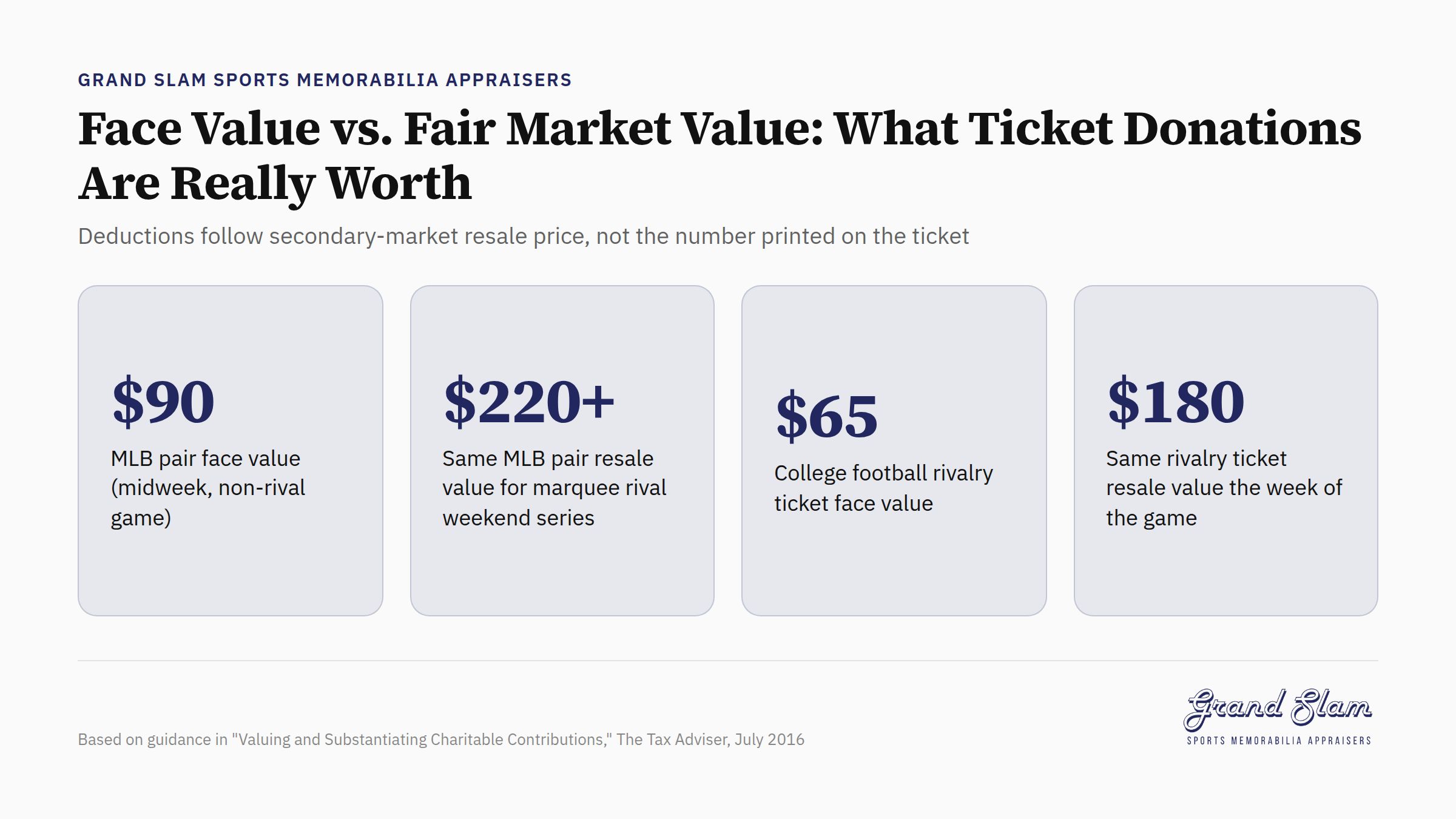
The deduction is based on fair market value, not the price printed on the ticket. Appraisers and tax professionals rely on secondary-market data, the kind of pricing you'd see on resale platforms, to establish what a willing buyer would actually pay near the date of the game. Face value is often a poor proxy for that number in either direction.
Example: A mid-tier pair of MLB regular-season tickets with a $90 combined face value might carry little resale premium for a midweek game against a non-rival opponent, while the same pair for a marquee weekend series against a division rival could resell for $220 or more. A college football rivalry-game ticket with a $65 face value might trade for $180 on the secondary market the week of the game. In both cases, the deduction should follow the resale figure, supported by dated comparables, not the number printed on the stub. Guidance on substantiating charitable contributions reinforces that the burden of proof for these values sits with the donor.
When the $5,000 Threshold Applies
As covered above, once the claimed deduction for a ticket or a group of similar tickets exceeds $5,000, a qualified appraisal and a signed Form 8283 become mandatory, not optional. Below that line, careful records and the required written acknowledgment are usually sufficient. Fans donating a single mid-value pair rarely cross the threshold; fans donating a season's worth of premium seats, a playoff strip, or a suite package often do. If you're unsure which side of the line your donation falls on, it's worth getting a value opinion before you file rather than after.
Timing the Donation: Why Earlier Beats Last-Minute
When you donate matters because the valuation itself is tied to a specific point in time. The tickets are valued as of the effective date, the date they're actually transferred to the charity, not the date of the game and not the date you first decided to give them away. Whatever fair market value applies on that effective date is what the appraisal and the deduction are built around.
That's also why timing affects the quality of the number, not just its existence. A qualified appraisal has to be dated close to the effective date of the contribution, and resale pricing for tickets can move quickly in the days before an event as demand firms up or a team's playoff odds shift. Donate early and the effective date lands in a period with stable, well-populated comparable sales. Donate the morning of the game and the effective date lands in the most volatile window of the entire pricing cycle, right when comparables can be thin or swinging by the hour.
There's a separate, practical reason to give charities lead time too: an organization that receives tickets days or weeks out can actually raffle, auction, or hand them to a family before the game happens. One that receives them hours before tip-off has far fewer options for using the gift. That's worth considering on its own, but it's a logistics question, not a valuation one. The valuation always follows the effective date, wherever that date happens to fall.
Frequently Asked Questions
Q: If I donate tickets to five different games from my season package, is that one donation or five for reporting purposes? It depends on whether the tickets are similar in nature and given to the same organization. The IRS generally groups similar tickets donated to one charity together when applying the $5,000 appraisal threshold, so five games from the same package to the same recipient are usually evaluated as a single group rather than five separate small gifts.
Q: I can't use a ticket and want to donate it the day before the game. Is that still worth doing? Yes. The valuation is based on the effective date, the date the tickets are actually donated, not the date of the game, so a last-minute gift still gets valued and can still support a deduction. The tradeoff is that resale pricing right before an event tends to be thinner and more volatile, so an appraisal dated that close to game day is working with less stable data. Donating earlier when you can gives both the valuation and the charity's ability to use the tickets more room to work with.
Q: Does donating through a team's official ticket-donation program change whether I need an appraisal? No. The appraisal requirement is based on the dollar value of your claimed deduction, not on which program facilitated the gift. A donation routed through an official team or league program still needs a qualified appraisal once it crosses the $5,000 threshold, and the program itself typically won't provide that valuation for you.
Q: Do luxury suite or premium hospitality packages get different appraisal treatment? The same threshold rules apply, but suites often require more careful valuation work because the package usually bundles tickets with food, beverage, and other services. An appraiser has to separate the value attributable to the seats and event access from the value of the hospitality components, since only certain elements typically factor into the charitable value.
Getting a Defensible Number Before You File
Donating tickets can be a genuinely good outcome for a charity and a legitimate deduction for the donor, but only when the paperwork matches the value being claimed. Confirm the recipient is qualified, secure your written acknowledgment for anything over $250, and get ahead of the $5,000 appraisal threshold before you file rather than after an audit letter arrives. Our appraisers hold credentials with organizations such as the ASA, ISA, and AAA, and prepare reports in accordance with USPAP and IRS requirements for Form 8283. If you're weighing a ticket donation and need a fair market value opinion behind it, request an appraisal before the season, or the deadline, gets away from you.
This article is provided for general informational purposes only and does not constitute legal, tax, or financial advice. Readers should consult a qualified attorney or CPA regarding their specific circumstances.