
Blog
Best Sports Card and Memorabilia Grading Services: PSA, Beckett, SGC, CGC, and JSA Compared
PSA, Beckett, SGC, CGC Cards, and autograph authenticators JSA and PSA/DNA each grade or authenticate differently, and the choice affects resale value and turnaround time. This guide compares their scales, tiers, and reputations, and explains why a graded item can still need a separate appraisal.
Grading and authentication turn a raw card, ball, or signed jersey into a market-standardized asset: a numeric grade or a letter of authenticity that collectors, auction houses, and insurers can read at a glance. Choosing the right service affects how quickly your item comes back, what it costs to submit, and often how much a buyer is willing to pay once it's encapsulated. This guide compares the five names that dominate the hobby: PSA, Beckett Grading Services (BGS), SGC, CGC Cards, and the leading autograph authenticators, JSA and PSA/DNA. If you're still working out what your collection might be worth, grading is a useful first step, but as the next section explains, it isn't the last one.
Grading vs. Appraisal: Two Different Services You'll Likely Need
Grading assesses a card's condition (or an autograph's authenticity) and assigns a standardized label. An appraisal assigns a dollar value for a specific purpose, such as insurance replacement cost, estate settlement, or a charitable donation deduction. A graded PSA 9 card and an appraised $40,000 collection are two different documents solving two different problems.
Most collectors assume that once a card carries a grading label, its value question is settled. It isn't. A grading slip tells an insurer or an executor that the card is authentic and describes its condition; it does not establish fair market value or replacement cost, and it isn't prepared to a valuation standard. Insurance carriers underwriting a scheduled collection typically want a credentialed report behind the number, which is why our team prepares sports memorabilia appraisals for insurance coverage as a distinct service from grading. The same is true when a graded collection passes through an estate; our sports memorabilia appraisal for estate tax service exists precisely because a stack of PSA slabs, however impressive, isn't a substitute for a defensible valuation. These reports are typically prepared in accordance with USPAP, the standard published by The Appraisal Foundation.
PSA (Professional Sports Authenticator)
PSA is the largest and most widely recognized third-party grading company in the hobby, grading cards on a 1-10 scale and authenticating autographs through its sister service, PSA/DNA.
Cards are graded from 1 (Poor) to 10 (Gem Mint), with half-point grades such as 6.5 or 7.5 used for cards that fall between whole numbers below an 8. A PSA 10 is the most sought-after result for modern cards, while scarce vintage cards routinely trade at strong prices even at a PSA 5 or 6, since survivorship rather than perfection drives the value.
PSA offers multiple submission tiers, ranging from a slower, lower-cost tier suited to lower declared-value items to faster tiers for higher declared-value or time-sensitive submissions. Turnaround times fluctuate with submission volume across the hobby and are never guaranteed, even at the fastest tier. Pricing is structured around the declared value the submitter assigns to the item and the turnaround speed selected, with higher declared-value tiers subject to additional scrutiny and a higher fee.
Because of its market share and long operating history, a PSA grade on a modern card tends to carry a distinct resale premium over the identical card graded by a competitor. PSA's population reports, which track how many examples of a given card exist at each grade, are widely used by buyers to judge scarcity before bidding.
Pro tip: Before submitting a card, check its population report at your target grade. A thin population at PSA 9 or 10 can justify paying for a faster tier so the card reaches the market while demand is high.
Beckett Grading Services (BGS)
BGS grades on the same 1-10 overall scale as PSA but adds four independent numeric subgrades: centering, corners, edges, and surface.
The overall grade generally tracks closely with the lowest subgrade, with some averaging built in. Beckett's rare "Black Label" designation is reserved for a BGS 10 with four perfect 10 subgrades, a combination that occurs infrequently enough that Black Label cards often command a premium over an equivalent PSA 10 of the same card.
Submission tiers and pricing follow the same general logic as PSA: a slower, economy-priced option for lower declared-value cards and progressively faster tiers as declared value and urgency increase, with turnaround always subject to volume at the time of submission.
Collectors who want a granular breakdown of exactly why a card missed gem mint tend to prefer Beckett, particularly for higher-end modern cards where the subgrade detail itself adds transparency and, at the Black Label tier, real market value.
SGC (Sportscard Guaranty Corporation)
SGC is best known in the vintage card market, grading cards on a 1-10 scale and housing them in a distinctive black "tuxedo" holder that has become a recognizable brand cue on its own.
SGC typically issues a single condition and authenticity grade without the subgrade breakdown Beckett offers. Its long operating history in the hobby makes it a trusted choice for pre-war and mid-century cards, where collectors often weigh grading consistency and holder presentation as heavily as the number itself.
Turnaround and pricing tiers mirror the industry pattern: slower options for standard submissions, faster options for higher declared value or urgent needs, with published estimates understood as fluctuating rather than fixed. In recent years, SGC has also picked up crossover interest from modern card collectors, partly on the strength of its holder design and partly on competitive turnaround at certain tiers.
CGC Cards (Certified Sports Guaranty)
CGC Cards is the trading card grading arm of the Certified Collectibles Group, which built its reputation in comics and coins before entering sports and trading cards.
CGC Cards grades on a 1-10 scale and has emphasized tamper-evident holders and QR-code verification tied to each certification number, a feature aimed at giving buyers an easy way to confirm authenticity online. As a newer entrant compared with PSA, Beckett, and SGC, CGC has grown quickly in modern and non-sports categories in particular.
Turnaround tiers and declared-value-based pricing follow the same general structure used across the industry. CGC's standing in secondary-market resale premiums is still developing relative to the three legacy grading companies, though acceptance among dealers and collectors has expanded steadily.
Watch out: Cracking a card out of one company's holder to resubmit it to another in hopes of a higher number carries real risk. Cards can be damaged during removal, and a lower grade the second time around is always possible.
Autograph Authentication: JSA and PSA/DNA
Unlike card grading, autograph authentication doesn't use a numeric scale. JSA and PSA/DNA each issue a letter of authenticity (LOA) or certification stating an expert opinion on whether a signature is genuine.
James Spence Authentication (JSA) built an independent reputation apart from any grading company and is widely accepted by major auction houses. JSA issues LOAs along with sticker or hologram tags applied directly to signed items.
PSA/DNA is PSA's sister authentication service and is frequently used when a signed card is being encapsulated in a PSA holder, allowing an "Auto" designation to appear directly on the card's label alongside its numeric grade.
Because autograph authentication is a matter of expert opinion rather than a measurable checklist of corner wear or centering, the credibility of the authenticator carries outsized weight in resale value and in whether a major auction house will accept the item for consignment.
Comparing the Grading Companies at a Glance
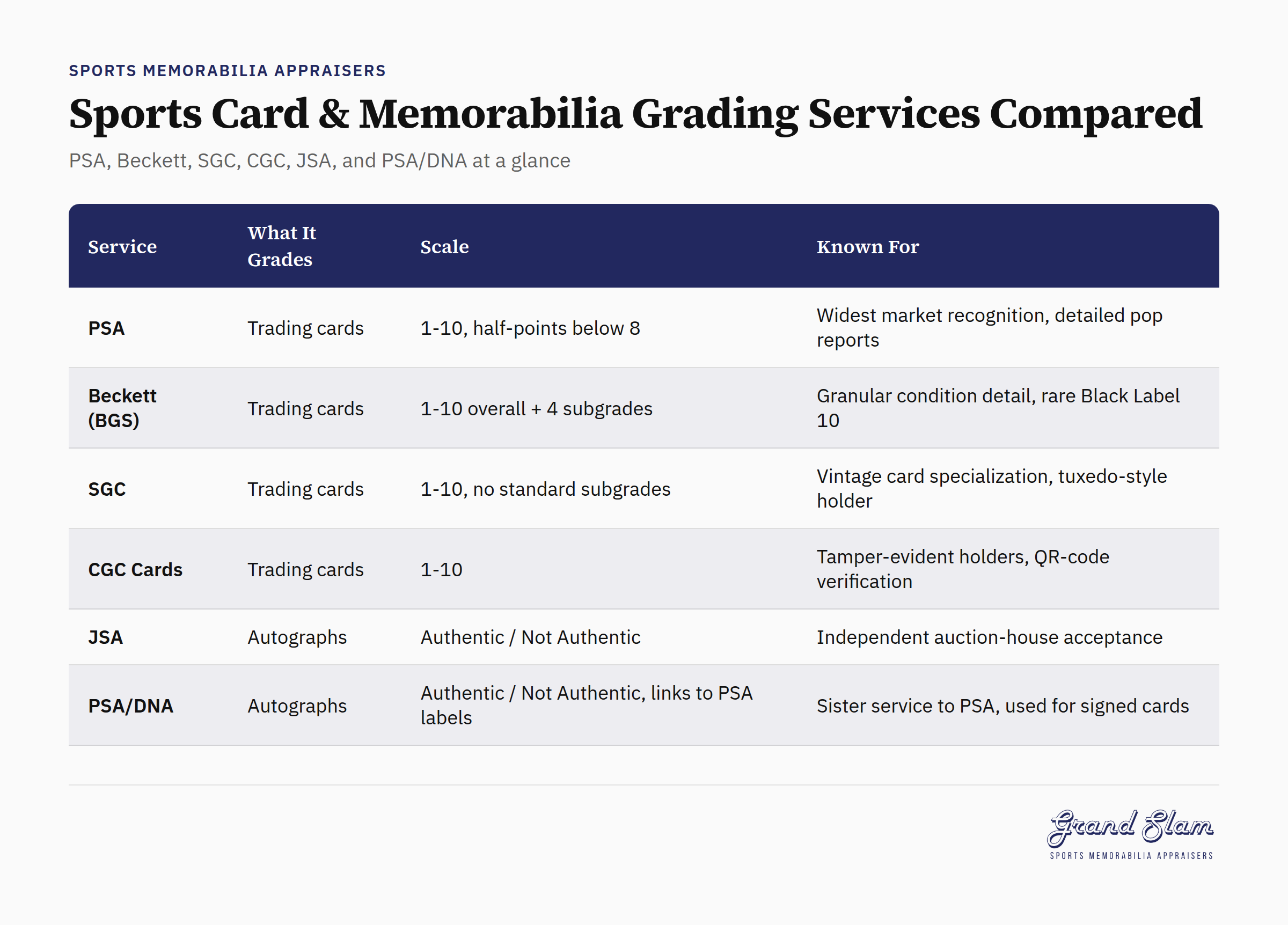
The table below summarizes what each service grades, how its scale works, and what it's best known for in the current market.
| Service | What It Grades | Scale | Known For |
|---|---|---|---|
| PSA | Trading cards | 1-10, with half-point grades below 8 | Widest market recognition, detailed population reports |
| Beckett (BGS) | Trading cards | 1-10 overall plus four numeric subgrades | Granular condition detail, rare "Black Label" 10 |
| SGC | Trading cards | 1-10, no standard subgrades | Vintage card specialization, tuxedo-style holder |
| CGC Cards | Trading cards | 1-10 | Tamper-evident holders, QR-code verification |
| JSA | Autographs | Authentic / Not Authentic (letter of opinion) | Independent auction-house acceptance |
| PSA/DNA | Autographs | Authentic / Not Authentic, integrates with PSA card labels | Sister service to PSA, used for signed cards |
How to Choose the Right Grading Service for Your Item
The right choice depends on what you're submitting and what the market rewards for that category:
- Vintage cards (pre-1980): SGC's long track record and holder presentation make it a common default among vintage-focused collectors.
- High-value modern cards: PSA's brand recognition and population data tend to translate into the strongest resale premiums.
- Cards where condition detail matters: Beckett's four subgrades give buyers a transparent breakdown, useful for cards near the top of the grading scale.
- Newer or high-volume modern releases: CGC Cards has gained traction quickly and is worth comparing on turnaround and cost for these categories.
- Signed items: JSA or PSA/DNA authentication is typically required before a signed piece is considered fully documented for resale or consignment.
Across every company, submission tiers run from a slower, lower-cost option to faster express tiers, and pricing scales with the declared value you assign to the item along with the turnaround speed you select. Published turnaround windows fluctuate with how many submissions a company is processing at a given time and should never be treated as a guarantee.
When a Grading Label Isn't Enough
A grading slip is excellent evidence of condition and authenticity, but it stops short of answering the questions an insurer, a court, or the IRS actually asks: what is this collection worth, and who says so with the qualifications to back it up. For estates, donations, divorce settlements, or scheduling a collection on a homeowner's policy, that answer comes from a credentialed valuation rather than a certification number. Our appraisers regularly work directly with graded collections, treating the grading label as one input into a broader USPAP-compliant valuation rather than the final word on value.
Frequently Asked Questions
Q: Does grading affect a card's value? Yes, often significantly. Encapsulation by a recognized company confirms authenticity and standardizes the condition assessment, which reduces buyer uncertainty and typically supports a higher resale price than the same card sold raw. The size of that effect varies by grading company, card era, and grade achieved.
Q: How is grading different from an appraisal? Grading assigns a condition and/or authenticity label to a single item using a fixed scale. An appraisal is a valuation prepared for a specific purpose, such as insurance, estate tax, or a charitable donation, and typically covers a collection's fair market or replacement value rather than just its condition.
Q: Can a graded card still need an appraisal? Yes. A grading slip has no bearing on whether an insurer, an estate, or the IRS requires a separate valuation. Collectors settling an estate, donating memorabilia, or insuring a high-value collection generally still need a formal appraisal for estate tax purposes or a comparable report even after every item has been graded.
Q: Is a higher numeric grade always more valuable? Generally, but not automatically. A PSA 10 usually outsells a PSA 8 of the same card, but scarcity, the era of the card, and demand for that specific player or set can make a lower-graded vintage card worth far more than a higher-graded common modern card. Grade is one input into value, not the only one.
This article is provided for general informational purposes only and does not constitute legal, tax, or financial advice. Readers should consult a qualified attorney or CPA regarding their specific circumstances.